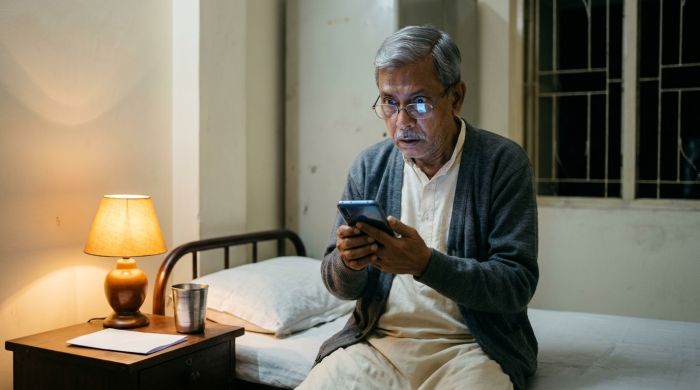
At 1:42 AM inside a quiet shared room at Shanti Kutir Senior Care Home in Baruipur, sixty-three-year-old Bimalendu Chatterjee stared at the glowing SMS on a borrowed spare phone: Rs. 14,00,000.00 debited via Scheduled RTGS from SBI A/c XX4819.
Three hours earlier, his elder son Soumya had sat weeping in the warden's office, laying down a stamped statement from that exact account to prove a collapsed agro-bond scheme had wiped Bimalendu down to one thousand eight hundred forty rupees.
For ten long seconds, Bimalendu could not even bring his thumb down to scroll.
Across the narrow aisle between their two iron cots, seventy-two-year-old retired schoolmaster Mr. Mukherjee breathed in a thin, whistling snore beneath a checkered cotton sheet.
The ceiling fan above them clicked softly on every fourth rotation, stirring the warm November air that smelled faintly of Dettol floor cleaner and damp concrete.
Bimalendu adjusted his thin steel-rimmed spectacles with trembling fingers and held the tiny backlit screen closer to his chest.
The sender ID was unmistakable: JX-SBIINB.
He read every single character twice, moving his lips silently in the dark as though speaking the numbers would stop them from sliding away.
Your A/c XX4819 debited by Rs.14,00,000.00 on 22NOV26 at 01:41 hrs via Scheduled RTGS to A/c XX9304. Ref SBINR52026112100481922.
Then came the final line at the bottom of the tiny grey display.
Avl Bal: Rs.14,12,840.00.
Bimalendu's breath caught somewhere behind his ribs.
If fourteen lakh rupees had just left the account at 1:41 AM, and another fourteen lakh twelve thousand eight hundred forty rupees still remained inside it, then twenty-eight lakh twelve thousand eight hundred forty rupees had been sitting peacefully in State Bank of India A/c XX4819 when dusk fell.
His late wife Aparna's life insurance payout, his thirty-four years of provident fund from Ganges Jute Machinery Works, his gratuity—none of it had vanished into any frozen bond market.
Slowly, Bimalendu turned his head toward the small wooden stool beside his pillow.
Under a dim yellow night bulb sat a stainless-steel tumbler of water, his strip of evening metformin tablets, and a crisp white sheet of paper folded into thirds.
He reached out and unfolded it with his left hand.
At the top stood the familiar blue keyhole emblem of State Bank of India, Jadavpur Branch.
At the bottom sat a smudged red rubber stamp reading ACCOUNT FROZEN / PENDING RECOVERY, beside a closing balance printed in neat black ink: Rs. 1,840.20.
Soumya had held that exact sheet between both palms at seven o'clock in the evening, his shoulders shaking as he told the care home warden that his poor father had been lured into a fraudulent infrastructure bond and lost every paisa of his life savings.
Even the warden—a brisk, middle-aged man named Anirban Bose who had clearly seen a hundred sad family stories walk through his iron gate—had looked across the desk at Bimalendu with a mixture of gentleness and quiet pity.
Anirban had slipped the subsidized charity-wing admission form across the table and lowered Bimalendu's monthly bed fee from twelve thousand rupees to seven thousand five hundred.
"Don't blame yourself, Chatterjee Babu," Anirban had murmured while signing the register. "At our age, smooth-talking agents fool even retired bank officers. At least your sons brought you somewhere clean where you won't miss your meals."
Bimalendu had sat there in his faded grey cardigan, too ashamed to lift his eyes from the linoleum floor.
He had felt like a foolish old burden who had somehow squandered forty years of careful living, forcing his grown boys to scramble for shelter on his behalf.
Now, at 1:46 AM, the borrowed spare phone grew warm in his palm.
Wait.
Why had this alert arrived on this borrowed phone at all—and how had Soumya managed to send fourteen lakh rupees while Bimalendu's own Airtel SIM card sat right here inside Baruipur?
Bimalendu swung his bare feet down onto the cold mosaic tiles, careful not to wake Mr. Mukherjee.
He slipped his feet into his worn rubber chappals, pulled his charcoal cardigan tighter across his chest, and stepped quietly out into the long veranda corridor.
A single tube light buzzed faintly above the reception counter at the far end of the hall.
Anirban Bose was still awake behind the glass partition, wearing half-moon reading glasses as he tallied kitchen milk invoices in a ruled ledger.
When Bimalendu's soft footsteps approached, the warden looked up in surprise, already half-rising from his plastic chair.
"Chatterjee Babu? Is everything alright? Are you having chest discomfort or breathlessness?"
Bimalendu did not answer with words right away.
He walked straight up to the counter and placed two things side by side under the white fluorescent glare: the folded bank printout Soumya had submitted at seven o'clock, and the borrowed Nokia handset glowing with the 1:42 AM message.
Anirban picked up the phone first, squinting down over the rim of his spectacles.
His fingers froze on the plastic keypad.
He looked from the screen to the red-stamped paper, then back up at Bimalendu's pale, weathered face.
"Wait a minute," Anirban said, his voice dropping low. "This is the same account number—XX4819. I wrote it into your admission file myself before dinner."
"Yes," Bimalendu whispered, his throat tight. "The one my son said was wiped out to eighteen hundred rupees."
"Then how on earth did fourteen lakh leave it twenty minutes ago—and why does it say fourteen lakh twelve thousand is still left?"
Bimalendu pressed one trembling knuckle against the wooden edge of the counter to steady himself.
All at once, a dozen small, overlooked details from the last twelve hours rushed back into focus with sickening clarity.
When Soumya arrived at Bimalendu's ground-floor flat in Bijoygarh, Jadavpur, at three in the afternoon to help pack two steel trunks, Bimalendu's cheap three-year-old smartphone had suddenly started shutting off whenever the battery dropped below forty percent.
During the forty-minute drive down Diamond Harbour Road and across the Baruipur bypass, Soumya had asked for the unlocked phone.
"Give it to me for ten minutes, Baba," Soumya had said from the front passenger seat while a hired driver navigated the evening traffic. "The care home needs your Aadhaar PDF downloaded on WhatsApp and your emergency contact updated."
Bimalendu had handed it over without a second thought.
Twenty minutes later, Soumya handed it back—and by nine o'clock at night, after Soumya had driven away promising to return on Sunday, the cracked smartphone died completely and refused to take a charge.
That was when Anirban Bose, noticing an anxious new resident clutching a dead telephone on his very first night away from home, had opened the office drawer and lent Bimalendu a spare office 4G phone, moving his Airtel SIM card across with a paperclip.
Anirban stared at the spare phone in his hand, his sharp administrator's mind connecting the dots almost as fast as Bimalendu.
"Chatterjee Babu," Anirban said quietly, "look at the wording on this alert. It does not say IMPS. It says Scheduled RTGS."
Bimalendu blinked behind his spectacles. "Meaning?"
"Meaning whoever initiated this did not need an OTP at one-forty in the morning," Anirban replied grimly. "On SBI NetBanking or YONO, if you schedule an RTGS transfer for the next calendar day's early clearing window, the bank asks for the OTP when you schedule it—not when it executes after midnight."
The room seemed to tilt slightly beneath Bimalendu's sandals.
At 4:15 PM in the front seat of the car, while Soumya claimed he was downloading an Aadhaar PDF, Bimalendu's Airtel SIM had been inside that cracked smartphone—and Soumya had been holding it unlocked.
And why hadn't Bimalendu noticed any SBI alerts during the past two months?
Because back in September, Soumya had taken Bimalendu's phone for an afternoon to "clean out spam loan messages" and install YONO so his aging father would not have to stand in bank queues.
Once the SIM moved into Anirban's clean, unblocked office Nokia at nine-thirty tonight, every blocked filter vanished—and the bank's 1:42 AM truth rang straight into Bimalendu's palm.
Anirban gently pulled a plastic stool around the counter and motioned for Bimalendu to sit.
"Before we panic or shout at anyone, drink half a glass of water," Anirban said firmly. "Because if fourteen lakh twelve thousand is still sitting inside that account, we have until morning—or less—before a second transfer clears."
Bimalendu sat down heavily, staring at the dark courtyard beyond the reception grille.
For sixty-three years, he had believed that if a man worked honestly, paid every electricity bill before the due date, and never asked his children for a rupee in his old age, his family would never treat him like an obstacle to be cleared off a balance sheet.
Yet as he gripped the warm plastic edge of the borrowed phone, a deeper, colder ache settled beside the shock.
It wasn't just the fourteen lakh rupees.
It was the realization of how carefully his elder son had built a stage where Bimalendu looked broken, broke, and helpless—just to push him out of his own home while emptying his life's work behind closed doors.
Wait until sunrise, and another fourteen lakh would disappear.
Wait until Sunday, and his entire life in Jadavpur would be gone.
Four years earlier, nobody in Bijoygarh Lane would have imagined Bimalendu Chatterjee sleeping on a charity-subsidized iron cot thirty kilometers outside southern Kolkata.
For thirty-four years, Bimalendu had risen at five-thirty every morning, soaked two teaspoons of fenugreek seeds in a brass cup for his sugar, and caught the local train from Jadavpur to Howrah where he worked as a senior electrical maintenance supervisor at Ganges Jute Machinery Works.
He was not a wealthy man or a white-collar officer.
His hands carried faint white scars from copper motor windings, and his hearing in his left ear was slightly dull from three decades beside humming industrial looms.
Yet inside his modest two-bedroom ground-floor flat—thirty-eight-B, Bijoygarh Lane, bought brick by brick with a twenty-year HDFC housing loan he finally closed at age fifty-six—there had always been hot mustard-fish curry on Sundays, neatly ironed cotton shirts, and zero unpaid debt.
His wife Aparna had managed every household rupee with quiet discipline until chronic kidney disease took her away four monsoons ago.
During her final eight months at a private hospital off the EM Bypass, Bimalendu never once asked either son to break a savings plan.
He used his factory medical coverage, dipped briefly into his overtime savings, and slept on plastic waiting-room benches beside the nephrology ward until the morning she passed peacefully holding his thumb.
After the thirteenth-day shraddh ritual ended and the relatives went home, his factory retirement settled neatly into his State Bank of India Jadavpur branch passbook.
Combined with Aparna's matured LIC policy and his own Employee Provident Fund, the total corpus came to twenty-eight lakh twelve thousand rupees—tucked cleanly into a five-year Senior Citizens' Savings Scheme and a linked Multi Option Deposit sweep-in account.
His monthly EPS-95 pension was a modest four thousand two hundred rupees.
Most men his age would have begun drawing down their savings immediately or moved in with one of their sons.
Bimalendu did neither.
Three months after Aparna's death, an old acquaintance from his morning park walk told him that Swapna Neer Abasan, a quiet forty-flat cooperative housing complex in Salt Lake Sector II, needed a reliable retired supervisor to oversee night gate security and pump operations from eight at night to six in the morning.
"You don't need to lift heavy loads, Bimal-da," his friend had said. "Just keep the watchmen awake, check the water motor log, and make sure delivery boys sign the register."
Bimalendu took the job the very next Monday.
To his neighbors in Jadavpur, he joked lightly that sitting alone under Aparna's quiet ceiling fan after sunset made the walls feel too narrow.
The deeper truth was simpler: his sixteen-thousand-five-hundred-rupee night-guard salary covered his groceries, utility bills, and diabetes strips completely—so that not one rupee of the twenty-eight lakh principal had to be touched.
"If either boy ever faces a real medical crisis or a roof repair, I won't be a father who begs with empty hands," he used to tell his neighbor Subrata Sen over evening muri and tea.
Yet as the years passed, Bimalendu's quiet self-sufficiency made it strangely easy for both sons to drift further away.
His elder son, Soumya, thirty-six, worked as a senior logistics coordinator for a shipping contractor near Taratala and lived with his wife Moumita and their nine-year-old daughter in a rented three-bedroom apartment in Garia.
On festivals and wedding invitations, Soumya always looked prosperous—crisp linen shirts, a financed white compact SUV parked by the curb, and polite, confident speech that impressed older uncles.
Moumita rarely visited Bijoygarh Lane, always citing dust allergies or her daughter's weekend tuition schedule, though she never hesitated to send Soumya over before Durga Puja for cash gifts or extra money when school annual fees came due.
Bimalendu's younger son, Rohan, thirty-one, worked long rotating shifts as a backend IT support analyst for a mid-tier vendor in New Town.
Unlike Soumya, Rohan was soft-spoken and rarely asked for money—yet he was perpetually exhausted, glued to work Slack pings on his phone, and quick to outsource every family decision with the same five words: "Dada is handling it, Baba."
Whenever Bimalendu slipped on the bathroom tiles in April or ran a high viral fever during August, Rohan would send five thousand rupees over UPI with a rushed message—"Order medicines on Tata 1mg, Baba, stuck in a client migration"—while Soumya would drop by for fifteen minutes on a Sunday afternoon, sigh loudly about how "unsafe" it was for a sixty-three-year-old widower to live alone on a ground floor, and leave before the kettle boiled.
Then, in late July, Soumya arrived at Bijoygarh Lane on a Tuesday evening—not alone, but with a smooth-talking man in a pale blue shirt named Debashis Roy.
Soumya introduced Debashis as an independent wealth advisor who handled corporate treasury placements for senior Taratala managers.
Spread across Bimalendu's teak dining table were glossy laminated brochures stamped with an emblem reading Eastern Horizon Infrastructure & Agro Bonds.
"Baba, look at the math," Soumya had urged, tapping a highlighted row on the brochure while Debashis nodded serenely beside him. "Your SBI deposit barely yields eight percent after TDS headaches. Eastern Horizon pays fourteen-point-two percent quarterly, backed by cold-storage warehouses in Burdwan. With twenty-eight lakh in, you get nearly thirty-three thousand every single month without working night shifts at Salt Lake."
Bimalendu had picked up the glossy sheet, turned it over twice, and set it beside his tea saucer.
"Fourteen percent?" Bimalendu had asked evenly. "Even our jute factory cooperative couldn't pay twelve percent when orders were booming. Where does a cold-storage company earn enough profit to hand out fourteen-point-two percent every quarter?"
Debashis had smiled the patient smile of a man accustomed to skeptical elders, sliding out a laminated ID card and mentioning tax arbitrage and agricultural subsidies.
Bimalendu shook his head firmly.
"Thank you, Debashis Babu. I am sixty-three. I don't need thirty-three thousand a month. My Salt Lake job feeds me, and my SBI money lets me sleep without checking newspapers."
Soumya's smile vanished instantly.
After Debashis stepped outside to take a phone call on the lane, Soumya turned on his father with hurt, clipped anger.
"Do you know how humiliating that was, Baba? I brought a respected colleague here because I was trying to get you off a watchman's stool at midnight, and you treated us like roadside touts."
"I wasn't rude, Soumya," Bimalendu said quietly. "I just don't understand private bonds."
"You don't understand them because you never moved past 1995," Soumya snapped. "Everything is digital now. Even if you don't want Eastern Horizon, at least let me link your SBI account properly on YONO and consolidate your scattered deposits into one Sweep-in MOD so you don't lose interest sitting in savings."
Over the next three weeks, Soumya played that guilt like a slow violin.
He stopped answering Bimalendu's evening calls for four days, then told Rohan in a family WhatsApp group—within Bimalendu's view—that Baba didn't trust his own elder son with even basic banking literacy.
Finally, tired of the cold silence and desperate not to widen the rift between them, Bimalendu compromised.
He refused to sign any third-party bond application—no matter how hard Soumya pushed—but he agreed to let Soumya help him convert his maturing deposit into a single linked Multi Option Deposit inside SBI A/c XX4819 and set up YONO on his phone "so Soumya could monitor quarterly tax statements remotely."
For six weeks after that afternoon, Soumya became oddly attentive.
He dropped off sweets twice, checked Bimalendu's phone settings to "block spam loan calls," and asked casual questions about whether the Jadavpur flat's damp exterior wall needed waterproofing.
Then, ten days ago, the hammer fell.
Soumya arrived at eight in the morning—right after Bimalendu returned home from his Salt Lake night shift—looking pale, unshaven, and frantic.
He threw a folded printout onto the dining table beside a screenshot of a forwarded news bulletin on his own iPhone.
"Baba, something terrible happened," Soumya choked out, burying his face in both hands. "Remember when you signed the YONO mandate in August? I thought I was doing the right thing—I instructed a linkage into Eastern Horizon's senior tranche so you'd get the extra interest before winter. Yesterday, SEBI froze their escrow accounts. Twenty-eight lakh is trapped in liquidation."
Bimalendu felt his knees go hollow beneath his cotton lungi.
"You moved it?" he whispered. "I told you no. You gave me your word you only set up a bank sweep-in."
"I was trying to earn you double pension so you could quit night duty!" Soumya cried out, his voice cracking with tears that looked wholly real under the morning tubelight. "Look at the statement! I went to the branch print kiosk myself—only eighteen hundred forty rupees is left free! And worse—because our housing society flagged the ground-floor sewerage seepage yesterday, the municipal engineer said we have to vacate and dig the floor for four months."
Before Bimalendu could catch his breath or walk three blocks to SBI Jadavpur himself, Soumya turned the whole catastrophe into an urgent rescue mission.
He dialed Rohan on speakerphone right there at the dining table.
Rohan, half-asleep after a midnight deployment shift in New Town, listened to Soumya's breathless summary—a frozen scheme, an empty account, a leaking flat, and Moumita's diabetic mother staying in Garia's spare bedroom.
"Dada, wait, how did this happen?" Rohan stammered over the line. "Can't we put Baba in my New Town flat? Wait—my flatmate Subham hasn't vacated the second bedroom yet until December, and I'm on night shifts three days a week..."
"Don't worry, Rohan," Soumya interrupted smoothly, rubbing his forehead. "I found a quiet senior care home in Baruipur. Decent food, garden, doctor on call. Because Baba's statement shows near-zero liquidity, the warden agreed to give him the subsidized bed at seven thousand five hundred a month. You and I can split it until the flat repairs finish and the court releases his bond money."
Bimalendu remembered sitting silent at his own dining table, feeling strangely small and ashamed.
He hadn't even gone to the bank branch to check.
He had felt sorry for Soumya's trembling voice, sorry for burdening Rohan's career, and stupid for trusting anyone with his phone.
So he resigned cleanly from his Salt Lake night-guard post on Friday, packed two steel trunks on Saturday afternoon, and climbed into the back seat of the hired cab while Soumya sat up front asking for his unlocked phone to download an Aadhaar PDF.
Now, sitting on a plastic stool under the buzzing reception tube light at Shanti Kutir at 2:00 AM, Bimalendu looked down at the glowing phone screen again.
There had never been any Eastern Horizon bond freeze.
There had never been any loss.
Every single rupee had sat safely inside SBI A/c XX4819—until his own elder son had looked him in the eye, wept over a doctored statement, packed him thirty kilometers away like discarded furniture, and scheduled fourteen lakh rupees to vanish while he slept.
Anirban Bose did not waste a single second on hollow sympathy.
He leaned across the reception desk, slid a thick laminated directory from beneath his ledger, and pointed a blunt finger at two helpline numbers printed near the top margin.
"First, we freeze every digital channel on that account before two-thirty," Anirban said crisply. "Once the next morning clearing window opens, nobody can tell whether another scheduled transfer is sitting in the queue."
Bimalendu nodded once, his fingers steadying slightly as action replaced helplessness.
He picked up the care home's corded landline receiver with one hand while holding the borrowed phone beside it to read off his exact account digits.
At 2:14 AM, he dialed SBI's twenty-four-hour toll-free fraud and channel-blocking desk.
The automated voice prompt took nearly three minutes of menu selections before transferring him to a calm night-shift executive stationed in Hyderabad.
"Sir, I am sixty-three years old, my name is Bimalendu Chatterjee, and an unauthorized scheduled RTGS of fourteen lakh rupees just cleared from my Jadavpur savings account XX4819 without my consent," Bimalendu stated slowly, reading his PAN and date of birth from the admission folder Anirban pushed under his elbow.
"I need an immediate emergency block on all NetBanking, YONO, UPI, and debit card transactions on my account right now."
Two minutes later, after verifying his mother's maiden name and his registered mobile number, the executive issued a confirmation reference number and locked every digital channel tied to A/c XX4819.
"No online transfer, scheduled mandate, or YONO login can execute until you visit your home branch in person with original KYC," the executive assured him.
Bimalendu exhaled for the first time in half an hour, writing the block reference across the corner of an old prescription envelope Anirban handed him.
Anirban was already dialing the next number on speakerphone.
"Now we call 1930," the warden said firmly. "Every bank fraud officer I have ever dealt with says the same thing: if you report within the golden hours before morning clearing opens at the receiving bank, the nodal desk can put a lien on the money before anyone withdraws it in cash."
It took four rings for the West Bengal Cyber Crime 1930 operator to pick up.
At 2:29 AM, sitting in a quiet Baruipur care home reception smelling of mosquito coil and cold tea, Bimalendu dictated the exact details: A/c XX4819, the recipient account ending in 9304, the RTGS reference number SBINR52026112100481922, and the exact timestamp of 1:41 AM.
When the operator read back his National Cyber Crime Reporting Portal acknowledgment number, Bimalendu copied every digit twice into Anirban's notebook.
Only then did Anirban step over to a stainless-steel electric kettle on the corner shelf and brew two cups of strong black tea without milk.
When he placed the steaming porcelain cup beside Bimalendu's elbow, the older man stared down at the dark liquid without lifting it.
"Your son," Anirban said gently, leaning back against the medicine cabinet. "Are you sure it was Soumya? Could someone at the bond office or a cyber café have stolen his YONO access?"
Bimalendu wished—more fiercely than he had wished for anything since Aparna's final night in the ICU—that the answer could be yes.
He picked up the folded statement Soumya had handed him before dinner.
"Look at the stamp, Anirban Babu," Bimalendu said quietly. "Account Frozen. Balance one thousand eight hundred forty rupees and twenty paise. A stranger at a cyber café didn't print this and hand it to my younger son on WhatsApp. A stranger didn't cry in your office to get a subsidized bed for seven thousand five hundred rupees."
Anirban's jaw tightened slowly.
"And the sewerage repair notice at your Jadavpur flat?" Anirban asked. "Did you ever see the municipal paper with your own eyes?"
Bimalendu slowly shook his head.
He had taken Soumya's word for that too.
Just as he had taken Soumya's word that his phone needed spam blocking.
Just as he had stayed silent whenever Moumita complained that ground-floor flats in Bijoygarh smelled damp, or when both sons discussed his retirement as though he were a child who had misplaced his school tiffin box.
For the next three hours, neither man tried to sleep.
At 5:45 AM, as pale grey light began edging through the iron-grilled corridor window and a distant milkman's bicycle bell jingled along the Baruipur main road, Bimalendu walked quietly back to Shared Room 4, washed his face with cold tap water, and dressed in his clean cream cotton kurta and grey cardigan.
Mr. Mukherjee stirred beneath his sheet, blinking sleepily as Bimalendu slipped his bank passbook and Aadhaar card into an old cloth zipper pouch.
"Going for a walk so early, Chatterjee?" the retired schoolmaster murmured.
"To set a few accounts straight, Dada," Bimalendu replied softly. "I will be back before evening, or I may not need this bed after all."
At 6:05 AM sharp, standing under a spreading neem tree in the quiet front courtyard of Shanti Kutir while stray crows argued on the boundary wall, Bimalendu dialed two numbers from the spare phone.
First, he called his younger son, Rohan.
It rang six times before Rohan answered in a groggy, irritable mumble.
"Hello? Baba? Why are you calling at six in the morning? Is something wrong at the home?"
"Nothing is wrong with my health, Rohan," Bimalendu said, keeping his voice steady and unreadable. "I wanted to ask you one plain question. Last week, when Soumya told you my savings were lost in Eastern Horizon Bonds, did you ever see the bond certificate yourself, or speak to any officer at SBI Jadavpur?"
There was a rustle of bedsheets on the other end, followed by an uncomfortable silence.
"Baba, please," Rohan sighed, rubbing his face audibly. "Don't start doubting things before sunrise. Dada forwarded the frozen account statement in our group chat—you saw the red bank stamp yourself. Why would Dada lie about your own money? Look, I worked till two AM on a client patch and I have a nine o'clock stand-up. Let me sleep two more hours and I will try to visit next weekend."
"Next weekend," Bimalendu repeated softly. "Tell me one more thing, Rohan. When did you last step inside thirty-eight-B Bijoygarh Lane?"
"August," Rohan muttered defensively. "Maybe early September for Vishwakarma Puja. You know New Town traffic takes ninety minutes each way. Go rest, Baba. Have your breakfast."
Rohan hung up before Bimalendu could say another word.
Bimalendu stood motionless beneath the neem tree for a long moment, listening to the faint rumble of a morning local train crossing the Baruipur tracks.
He was not angry at Rohan—not yet. What he felt was a colder, quieter grief: the sudden recognition of how effortlessly convenience turns loving children into strangers who accept any story as long as it spares them an inconvenient Sunday drive.
Then he pressed his second call.
Subrata Sen, fifty-eight, retired railway accounts clerk and Bimalendu's neighbor directly across narrow Bijoygarh Lane for twenty-two years, picked up on the second ring.
"Bimal-da!" Subrata's cheerful voice crackled warmly through the receiver. "Didn't expect your ring so early! Settled in alright at Baruipur? My wife was grumbling all yesterday evening that you left without letting her pack two jars of kasundi."
"Subrata, do me a small favor right now," Bimalendu said quietly. "Step out onto your front veranda with your morning tea and look straight across at my flat's iron gate."
"At six-fifteen in the morning? Why—did you forget to lock the padlock?"
"Soumya told me the Kolkata Municipal Corporation served a drainage repair notice and masons were arriving early this morning to dig up my veranda floor," Bimalendu said. "Tell me what you actually see."
He heard the scrape of Subrata's wooden door bolt, the shuffle of slippers on concrete, and a bird chirping outside in Bijoygarh Lane.
Then Subrata stopped talking completely.
Five seconds stretched into ten.
"Subrata?" Bimalendu pressed gently.
"Bimal-da," Subrata said, his cheerful tone gone flat with disbelief. "There is no municipal worker here. There isn't a single sack of sand or cement anywhere on the lane."
"Then what is at my gate?"
"A freshly printed yellow flex board tied to your front grill with green nylon rope," Subrata said grimly. "It says TO-LET: TWO-BHK GROUND FLOOR, FAMILY OR WORKING BACHELORS, CONTACT NIRMAL PROPERTY. And wait—there is a fellow in a checkered shirt standing on your front steps right now taking pictures of the veranda with his mobile phone."
Bimalendu closed his eyes behind his spectacles.
Every lingering hope that he might have misread a clerical error died completely beneath that neem tree.
While he had been riding down Diamond Harbour Road believing his home was unlivable and his pension had vanished, his elder son had already handed the spare house keys to a neighborhood broker.
"Subrata," Bimalendu said, his voice suddenly steady as forged iron, "walk across the lane right now. Ask that broker who gave him the keys, tell him the registered owner has not authorized any tenancy, and stand by my gate until I reach Jadavpur at ten o'clock."
"Already stepping over with my walking stick, Bimal-da," Subrata barked angrily. "Let this broker try stepping one inch past your grill!"
At 8:15 AM, when Bimalendu walked back into the care home reception carrying his cloth pouch, Anirban Bose had already pulled his silver 2014 WagonR up to the front gate and left the night supervisor in charge of breakfast trays.
"You are not riding a crowded Baruipur train alone with a shaky heart today," Anirban told him simply, unlocking the passenger door. "Your branch opens at ten. We leave now so we beat the Gariahat and Kamalgazi morning jam."
At 9:48 AM, Bimalendu and Anirban stood beneath the faded blue awning outside State Bank of India, Jadavpur Main Branch, on Raja Subodh Chandra Mallick Road.
A tea vendor near the bus stop poured cardamom chai into small clay bhanrs while auto-rickshaws rattled past toward 8B Bus Stand.
Ten minutes earlier, the spare phone in Bimalendu's kurta pocket had started ringing nonstop—first from Moumita, then twice from Soumya.
Apparently Soumya had tried calling Bimalendu's dead smartphone at eight-thirty, panicked when it stayed switched off, and dialed Shanti Kutir's landline only to hear from the day assistant that Bimalendu had left early with the warden.
Bimalendu ignored Soumya's calls completely.
Instead, at 9:52 AM, he dialed Rohan once more.
This time Rohan picked up on the first ring, breathless and worried.
"Baba? Dada just called me frantically saying you left the care home without telling anyone and your phone is unreachable! Where are you?"
"I am standing outside SBI Jadavpur Main Branch," Bimalendu answered calmly. "And I am about to walk inside to sit with the Branch Manager."
"SBI? Why? Baba, Dada already showed us the account is frozen—"
"Rohan," Bimalendu interrupted quietly, and something in his father's tone made the young IT engineer go dead silent. "Listen carefully. For ten years I never asked you for a single rupee or a single Sunday you couldn't spare. Today I am asking you for one hour. Leave your New Town desk, take a cab to Raja S.C. Mallick Road, and be inside SBI Jadavpur before ten-thirty. Bring the WhatsApp PDF Soumya sent you."
"Baba, what is going on? You're scaring me."
"If you care whether your father has been robbed—and by whom—be here in thirty minutes," Bimalendu said, and ended the call.
At 10:02 AM, the rolling shutters of SBI Jadavpur Main Branch rattled upward and the security guard stepped aside to let the first handful of senior citizens in.
Bimalendu walked straight past the token counter to the frosted-glass cabin at the back bearing a small brass nameplate: KAVITA MUKHERJEE, CHIEF MANAGER.
Kavita Mukherjee, forty-seven, crisp in a handloom cotton sari with reading glasses perched on a steel chain around her neck, had barely switched on her desktop monitor when Bimalendu tapped lightly on her open door.
"Come in, Sir," she said briskly, gesturing to two visitor chairs. "How may I help you this morning?"
Bimalendu placed four items carefully onto the glass top of her desk: his original Aadhaar card, his genuine stitched green-and-blue SBI passbook, the red-stamped printout Soumya had submitted in Baruipur, and the slip of paper carrying his 2:14 AM channel-block reference and 2:29 AM 1930 Cyber Crime acknowledgment number.
Kavita Mukherjee glanced at the 1930 reference number first, and her brisk morning posture sharpened instantly into full professional focus.
"Please sit down, Chatterjee Babu," she said, typing rapidly into the core banking terminal. "Who is accompanying you?"
"Anirban Bose," Bimalendu said. "He manages Shanti Kutir Senior Care Home where my elder son admitted me last night as a penniless dependent."
Kavita's fingers paused for a split second before resuming across the keyboard.
For three full minutes, the only sound in the cabin was the quiet hum of the split air conditioner and the click of Kavita's mouse as she pulled up account history, Multi Option Deposit sweeps, device binding logs, and outward RTGS clearing records.
Slowly, her expression hardened.
She turned her thick monitor slightly angled toward Bimalendu and Anirban, though neither leaned across the desk until she spoke.
"Chatterjee Babu," Kavita began carefully, "first let me ask you a direct question. Have you ever heard of a firm called Eastern Horizon Infrastructure & Agro Bonds inside this bank?"
"My son brought a broker named Debashis Roy to my house in July," Bimalendu said evenly. "I refused to sign any bond paper. Then ten days ago my son told me he had linked my YONO mandate into their senior tranche anyway, and that SEBI froze all twenty-eight lakh."
Kavita picked up the folded printout Soumya had used at the care home, turning it toward the morning window light.
"First of all," she said coldly, "this sheet is a crude fabrication. State Bank of India Jadavpur Branch does not even own a red stamp with that font, and our passbook printer never generates account summaries without branch IFSC headers and page serial codes. Someone edited a PDF on a computer and bought a two-hundred-rupee stationery stamp."
Anirban let out a low, sharp breath beside Bimalendu.
"Second," Kavita continued, tapping her screen, "zero rupees—not even one paisa—were ever transferred from A/c XX4819 to any agro-bond company in July, August, September, or October. All twenty-eight lakh twelve thousand eight hundred forty rupees sat quietly inside your linked Multi Option Deposit sweep-in right here in Jadavpur until yesterday afternoon."
Bimalendu's fingers curled tightly around the wooden armrests of his chair. Hearing it verified off an official bank ledger hurt differently than suspecting it in the dark.
"Yesterday afternoon," Bimalendu repeated softly. "At four-eighteen?"
Kavita looked up in surprise. "How did you know the exact minute?"
"Because at four-fifteen my son took my unlocked phone in the front seat of a cab near Baruipur saying he needed to send my Aadhaar PDF," Bimalendu said.
Kavita nodded grimly, scrolling down the audit trail.
"That matches our digital log down to the second," she confirmed. "Four days ago—on November eighteenth—a new third-party beneficiary was added on your YONO profile: D.R. Logistics & Commodities, Current Account XX9304 with HDFC Bank, Salt Lake Sector V Branch. Adding a beneficiary triggered the mandatory cooling period and limit cap."
"That's why he couldn't take all twenty-eight lakh at once," Anirban murmured.
"Correct," Kavita said, pointing at two highlighted rows on her screen. "Yesterday at 4:18 PM, two separate Scheduled RTGS instructions of fourteen lakh rupees each were authorized from your registered device using mobile OTP. The first fourteen lakh executed automatically at 1:41 AM today, leaving fourteen lakh twelve thousand eight hundred forty rupees behind. The second fourteen-lakh transfer was scheduled to execute tomorrow morning—and it sits right here in our rejected queue because of your 2:14 AM emergency channel block."
Bimalendu stared at the glowing blue lines on her monitor.
If his old smartphone hadn't died at nine o'clock last night, if Anirban hadn't lent him a clean handset with no blocked sender filters, by tomorrow noon every single paisa of thirty-four years at the jute machinery factory and Aparna's insurance would have been swept clean into Salt Lake Sector V—leaving him staring at a care home ceiling believing he only had himself to blame.
"Madam," Bimalendu asked, fighting to keep his voice even, "the fourteen lakh that settled at 1:41 AM—is it already gone?"
"Not necessarily," Kavita replied promptly, lifting her desk telephone receiver. "Because you filed your 1930 cyber fraud complaint at 2:29 AM—seven hours before HDFC's corporate clearing desk opens for morning cash or outward transfers—our fraud monitoring team has already flagged the 1930 ticket. Give me three minutes to speak directly with our regional nodal officer and send an urgent inter-bank lien hold to HDFC Salt Lake Sector V."
Just as Kavita Mukherjee replaced the receiver after dictating the urgent inter-bank hold mail, the heavy glass door of the main banking hall swung open sharply.
Soumya hurried inside wearing an unironed polo shirt and crumpled trousers, his hair uncombed, sweat glistening across his forehead despite the cool November morning.
Three paces behind him walked Rohan, still wearing his blue office ID lanyard around his neck, looking bewildered and pale.
Soumya spotted Bimalendu through the glass cabin partition immediately.
Relief—followed almost instantly by wary alarm when he saw Anirban Bose sitting beside his father—flashed across Soumya's face as he pushed the cabin door open without knocking.
"Baba!" Soumya called out loudly, forcing a breathless, worried smile while glaring briefly at Anirban. "What on earth made you run away from Shanti Kutir at dawn? You didn't answer my calls, Moumita is crying at home, and why are you troubling the Branch Manager when I told you the account is under legal freeze?"
Rohan stepped inside behind his brother, shutting the glass door halfway. "Baba, are you okay? Dada said you left without taking your sugar medicine—"
"I took my medicine at five-thirty, Rohan," Bimalendu said quietly, not rising from his chair. "And I am sitting here because at 1:42 AM last night, fourteen lakh rupees left the account Soumya swore was down to eighteen hundred rupees."
The color drained cleanly from Soumya's cheeks.
For two seconds his mouth opened and closed without sound before smooth panic kicked back in.
"Fourteen lakh? What nonsense—must be an old system alert or a bank server glitch!" Soumya stepped quickly toward the desk, leaning forward toward Kavita Mukherjee with practiced deference. "Madam, my father is sixty-three and very stressed since yesterday. Please explain to him quietly—there is some technical error on his old phone. Let me step outside with you for two minutes to sort this out."
Kavita Mukherjee did not budge an inch from her leather chair.
She leaned back slowly, folded her hands over Bimalendu's genuine passbook, and looked straight up at Soumya over the rim of her reading glasses.
"There is no server glitch, Mr. Chatterjee," Kavita said in a voice cold enough to rattle the glass partition. "At 4:18 PM yesterday, while your father sat beside you in a moving car toward Baruipur, his YONO profile authorized two Scheduled RTGS transfers of fourteen lakh rupees each to D.R. Logistics & Commodities at HDFC Salt Lake Sector V—an account belonging to a Mr. Debashis Roy."
Rohan spun his head sharply toward his elder brother. "Debashis Roy? Dada, isn't that the guy you brought home in July for the Eastern Horizon bond?"
Soumya swallowed hard, taking half a step backward toward the glass door. "R-Rohan, listen—Debashis was helping route the escrow recovery! You don't understand corporate treasury mechanics—"
"Enough," Kavita Mukherjee cut him off sharply, tapping the red-stamped paper on her desk. "Mr. Chatterjee, did you or did you not prepare this fabricated SBI account summary showing a balance of one thousand eight hundred forty rupees and present it to Shanti Kutir Senior Care Home last evening?"
Soumya stared down at the paper as though a snake had uncoiled across the desk.
"I—I was only trying to protect Baba from panicking while I cleared a temporary business liquidity gap," Soumya stammered, his smooth Taratala coordinator facade cracking wide open under the fluorescent cabin lights. "Debashis was going to return the funds once my freight billing cleared in January! Nobody was going to lose anything!"
"Temporary liquidity gap?" Bimalendu stood up slowly from his chair, and though he was half a head shorter than his thirty-six-year-old son, every muscle in the small room seemed to tighten around his quiet voice.
"You told my younger son my money was wiped out in a Ponzi collapse. You told my care home warden I was a broken charity case who couldn't afford twelve thousand rupees. You told me municipal engineers were digging up my bathroom floor—while your property broker was already hanging a To-Let board on my iron grill at six in the morning."
Rohan stared at Soumya in horrified disbelief, pulling out his own smartphone with shaking hands and opening their family WhatsApp thread.
"Dada..." Rohan whispered, his voice breaking. "Wait—this To-Let board... Baba's flat wasn't leaking? And the statement you sent me last week—you faked it? I told Titli's parents you had sacrificed your own savings to get Baba into Baruipur!"
"You stayed so busy with your New Town shifts you never even walked into my flat for three months," Soumya lashed back wildly, cornered and desperate. "Do you know what it costs to keep up appearances in Garia? Moumita's father's medical loans, school donations, the car EMI—and when that freight broker cheated me on two container contracts and I tried making it back in options trading with Debashis, he put a private interest note of thirteen lakh eighty thousand over my head by November twenty-second!"
Nobody spoke for five heavy seconds.
Outside the glass cabin, two bank clerks paused near the printer, glancing nervously toward the Manager's door.
Rohan sank slowly onto the spare corner chair beside the filing cabinet, burying his face in both hands as though the air had been knocked straight out of him.
"Options trading," Rohan choked out miserably. "You put Baba in an old-age home in Baruipur so you could pay off your options gambling debt with Debashis?"
"I was going to pay it back from the flat rent and my April bonus!" Soumya pleaded, dropping suddenly to one knee beside Bimalendu's chair and grabbing the hem of his father's charcoal cardigan. "Baba, please—call off the 1930 complaint right now! The bank officer hasn't sent the police yet, has she? If HDFC freezes Debashis's account under a cyber fraud case, they'll register an FIR against me at Jadavpur Thana! Think about Moumita, think about your granddaughter's school!"
Bimalendu looked down at his elder son kneeling on the bank carpet—the same boy whose fingers he had once wrapped carefully around a fountain pen on wooden veranda steps, the boy for whom he had worked Sunday overtime shifts in the Howrah foundry dust so he could study engineering without a single rupee of education loan.
A terrible stillness filled Bimalendu's chest.
He did not pull his cardigan away roughly, nor did he shout.
He gently uncurled Soumya's fingers from his sleeve, one by one.
"When you sat in the front seat of that cab yesterday," Bimalendu said softly, "watching me look back at my own gate thinking I was homeless and broke—did you think once about your father's heart?"
Before Soumya could answer, Kavita Mukherjee's desk phone buzzed once.
She lifted it, listened for twenty seconds, and set it down with a decisive click.
"HDFC Salt Lake Sector V nodal desk has placed an immediate debit freeze and lien mark on fourteen lakh rupees inside A/c XX9304," Kavita announced cleanly. "The entire amount was still sitting un-withdrawn in the current account because your 2:29 AM 1930 alert hit their system before morning clearing."
She glanced past Soumya toward the main banking hall entrance, where a uniformed Sub-Inspector from Jadavpur Police Station had just stepped inside alongside the branch security guard—routine protocol whenever a senior citizen branch fraud and 1930 inter-bank lien exceeded ten lakh rupees.
"And Officer Tapas Ghosh is here to record your statement, Chatterjee Babu," Kavita added quietly. "How you wish to proceed with the criminal complaint once the bank reversal completes is your decision—but the fraud report itself is already on official record."
The reversal did not happen by magic, nor did it wrap up in an afternoon.
That was the truth life after sixty taught a man: real accountability moves slowly, through stamped applications, police diaries, and quiet nights spent staring at an empty ceiling.
At Jadavpur Police Station later that morning, with Anirban Bose waiting faithfully outside on a wooden bench and Rohan sitting stiff and silent beside his father, Sub-Inspector Tapas Ghosh summoned Debashis Roy by phone from Salt Lake under Section 318 notice.
Faced with a frozen corporate current account, SBI's device-ID and timestamp logs, the forged red-stamped statement, and Bimalendu's clean 1930 golden-hour filing, Debashis Roy wanted no part of a custodial fraud charge.
Within four hours, sitting across the Sub-Inspector's scarred steel desk, both Soumya and Debashis signed written no-objection and bank-reversal consent undertakings agreeing to unwind the unauthorized fourteen-lakh RTGS back into SBI A/c XX4819—leaving Soumya to settle his personal trading loan with Debashis through his own salaried installments and the immediate sale of his financed SUV.
It took nine working days for the inter-bank nodal verification, HDFC compliance clearance, and Jadavpur Police Station closure report to route the full fourteen lakh rupees back into Bimalendu's passbook.
Wait—Bimalendu did not spend those nine days at Shanti Kutir.
At four o'clock that very first afternoon, Anirban Bose drove his silver WagonR straight down Raja S.C. Mallick Road into Bijoygarh Lane, where Subrata Sen had long since chased off the bewildered property broker and cut the yellow TO-LET board down with kitchen shears.
Together, Anirban and Subrata carried Bimalendu's two steel trunks back across the familiar damp threshold of 38B, Bijoygarh Lane.
Subrata's wife, Bela, walked over ten minutes later carrying a hot steel tiffin carrier of moong dal, fried pointed gourd, and steamed rice, refusing to leave until Bimalendu ate every bite at his own teak dining table.
On Saturday morning—three days after the branch confrontation, while Soumya remained silent in Garia sorting out the sale of his car under Moumita's furious weeping—a quiet knock sounded at Bimalendu's iron grill gate.
It was Rohan.
He carried no laptop bag today, no office lanyard, no hasty excuses about client deployments.
His eyes were dark-ringed and swollen as he stepped inside, set a small cloth bag of ripe malbhog bananas on the kitchen counter, and sat straight down on the cool red oxide floor beside Bimalendu's cane chair.
"Baba," Rohan whispered, staring hard at his own folded hands. "I don't expect you to forgive me quickly. Dada lied to me, yes—he showed me fake statements and scared me about municipal notices. But the truth is worse than that."
Bimalendu looked down quietly at his younger son's bowed head, saying nothing.
"I let him lie to me," Rohan continued, his voice trembling. "Because it was convenient. Because checking on you myself meant driving across traffic on Sundays, rearranging my spare bedroom, asking awkward questions about your money. When Dada said Shanti Kutir was best for you, I felt relieved instead of suspicious. I abandoned you just as much as he did."
Silence hung gently in the sunlit room, broken only by the distant call of a vegetable seller pushing his cart down Bijoygarh Lane.
Four years ago, Bimalendu might have patted his son's shoulder immediately, waved the apology away, and whispered that fathers never keep score.
Today, he knew better. Blind softness had nearly cost him his roof, his self-respect, and every memory inside these four walls.
Instead, Bimalendu reached down slowly and placed one scarred, steady hand on Rohan's shoulder.
"I hear you, Rohan," Bimalendu said evenly. "You were negligent, not cruel. There is a difference—and because there is a difference, I will not shut this gate in your face."
Rohan looked up with wet, hopeful eyes. "Come stay with me in New Town once my flatmate moves out next month, Baba. Please. Let me take care of you properly."
Bimalendu shook his head gently, a quiet smile touching the corners of his grey moustache.
"No, Khoka. That chapter is finished."
"Baba—"
"Listen to me carefully," Bimalendu said, his voice warm yet firm as granite. "I am sixty-three, not helpless. This house is paid for in full, in my own name. My salt, my rice, and my medicines come from my own pension and honest work—not charity. You are welcome at my dining table on Sundays, without your office phone buzzing between every bite, and I will gladly sit at your wedding when Titli's family fixes the date. But I keep my own keys. I sleep under my own roof. And nobody—not you, not Soumya, not any advisor—will ever touch my phone or my bank mandates again."
Rohan swallowed hard, tears spilling openly down his cheeks now, and nodded slowly without arguing.
"Yes, Baba," he whispered. "Whatever rules you set. I will show up properly from now on—not with UPI transfers, just in person."
As for Soumya: once the fourteen-lakh reversal credited cleanly on the tenth morning, Bimalendu signed the withdrawal of the custodial prosecution request so his nine-year-old granddaughter would not grow up visiting a father behind bars.
Yet forgiveness of prison did not mean erasure of consequence.
That afternoon, inside Kavita Mukherjee's cabin at SBI Jadavpur, Bimalendu permanently deactivated every YONO and NetBanking login tied to A/c XX4819, unblocked every bank SMS sender on a brand-new basic phone he bought himself with cash, and locked twenty-five lakh rupees directly into a Senior Citizens' Savings Scheme and non-callable physical-passbook Fixed Deposit—with a written branch mandate forbidding any third-party Power of Attorney, email change, or premature withdrawal without his own physical biometric verification inside the Jadavpur branch.
He also removed Soumya as sole primary nominee, updating his nomination cleanly and placing a sealed copy of his registered property deed inside a bank locker registered solely in his own name.
When Soumya showed up at Bijoygarh Lane two weeks later—humbled, thinner, driving an old second-hand scooter after selling the white SUV to settle Debashis—Bimalendu met him at the outer veranda gate rather than inviting him to the dining table.
"Bring my granddaughter here whenever she wants to see her grandfather's garden," Bimalendu told his elder son calmly across the iron grill. "As for you and me, trust is not rebuilt by saying sorry once. Pay off every debt from your own salary, live within what you earn, and maybe two years from today we can sit down over tea without lying to each other."
The following Saturday morning, Bimalendu took an early auto-rickshaw back down to Baruipur—not with two steel trunks, but with two clay pots of warm rosogolla from Jadavpur and a neatly typed laminated sheet tucked inside his cloth folder.
Anirban Bose came running out of the Shanti Kutir office the moment he saw Bimalendu step through the iron gate, beaming as though an old friend had returned from abroad.
After sharing tea with Mr. Mukherjee and half a dozen smiling residents in the sunny courtyard, Anirban pinned Bimalendu's laminated one-page safety sheet right beside the main dining hall notice board—and insisted on sending copies to every senior citizen's son and daughter on the care home's weekend mailing list.
Every rule on that sheet had been bought at the edge of two-thirty in the morning:
First, never hand an unlocked phone—or an OTP—to anyone, even family, during travel or hospital errands; if an account suddenly goes quiet without SMS alerts, walk straight into your bank branch and check if the bank sender ID has been muted or blocked.
Second, remember that Scheduled NEFT and RTGS transfers can be authorized during the day and settled after midnight without another OTP—so keep NetBanking or YONO turned off completely if you prefer walking into your branch.
Third, never accept printed PDFs, WhatsApp bond certificates, or stamped sheets as proof of loss; verify every rupee directly on a physical passbook update at the bank counter, and treat any private scheme promising twelve to fifteen percent guaranteed returns as a danger signal.
Fourth, lock retirement savings inside Senior Citizens' Savings Schemes or non-callable FDs with a written branch mandate requiring in-person biometric or physical signature confirmation for any premature closure.
And fifth, memorize 1930 and your bank's twenty-four-hour channel-blocking number before trouble knocks—because freezing digital channels and calling 1930 during the midnight golden hours is what saved fourteen lakh rupees before morning clearing opened.
By ten-thirty that morning, Bimalendu was back on his own sunlit veranda in Bijoygarh Lane, watching pigeons settle along the boundary wall while Subrata Sen pushed open the iron gate holding the Saturday Anandabazar Patrika.
Inside the kitchen, the brass kettle whistled softly over a low blue flame.
Swapna Neer Abasan in Salt Lake had already called twice asking if Bimalendu would return to his night supervisor desk on Monday—and Bimalendu had smiled, telling the secretary he would think about taking three shifts a week just for the brisk evening walks and good company.
He poured two steaming cups of Darjeeling tea into Aparna's old porcelain mugs and placed one across the cane table for his neighbor.
For sixty-three years, Bimalendu Chatterjee had worked with patience, copper wire, and quiet honesty—and sitting there in his own home with every rupee accounted for and every key firmly in his own hand, he finally understood that loving your children never meant surrendering your dignity just to keep the peace.