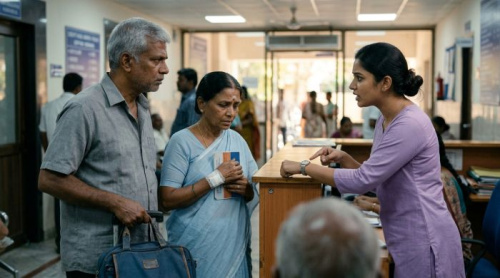
The dal-tadka had already formed a thin orange skin inside the steel casserole when Harishankar Tiwari pushed open the wooden door of his rented ground-floor flat in Aliganj, Lucknow.
It was 7:52 PM on a damp Friday in November, and his lower back ached from thirteen straight hours behind the steering wheel of his white Maruti Eeco pathology van.
He set his scratched aluminum tiffin carrier on the shoe rack beside the door and wiped fog off his spectacles with the hem of his faded khaki jacket.
"Harry, thank goodness you finally reached," his elder sister Shashi called from the narrow dining room, her voice tight enough to make him pause with one chappal still half-off.
Harishankar stepped into the dining area expecting to see his twenty-one-year-old daughter, Nandini, hunched over her college notes beside the salt cellar.
Instead, only two people sat around the four-seater teakwood table.
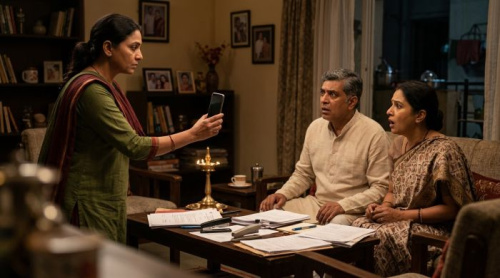
Shashi Bua was wringing the border of her cotton sari in her lap, while Maheshwar Mishra—Harishankar's late wife Kamla's elder brother—sat calmly on the corner chair in a crisp brown Nehru jacket over a cream kurta, stirring a half-finished cup of ginger tea.
"Where is Nandu?" Harishankar asked, glancing toward the tiny kitchen and the curtain over her bedroom doorway. "She texted me at four saying she was making gobhi parathas tonight."
"She stepped out around six-thirty," Shashi said quickly, rising from her chair. "She told me she was only running down to Sharma Photostat on the corner lane to print one extra Aadhaar copy. She said she would be back in ten minutes."
"Ten minutes?" Harishankar looked at the plastic wall clock above the sideboard. It was nearly eight. "In this mist? Why didn't you call her?"
"I tried calling twice from my keypad phone," Shashi said, pointing a trembling finger toward the center of the dining table. "Then I saw her mobile lying right there beside the sugar jar."
Harishankar stepped closer to the table.
Resting face-up between two uncovered stainless-steel plates and a half-drunk tumbler of water was Nandini's dark-blue Vivo smartphone—and tucked neatly beneath the edge of the phone charger was a folded yellow sticky note in her neat, rounded handwriting.
He picked up the slip first.
Papa, don't let the parathas get cold. Back in 15 mins.
Nobody takes their maroon cloth college bag, their heavy woollen shawl, and their street sandals just to walk four houses down to a photocopy shop in Aliganj Sector-H.
Harishankar looked across the table at Maheshwar, who had not stood up once since Harishankar walked in.
"Maheshwar bhaiya, you reached at seven, right?" Harishankar asked, keeping his tone steady though a cold knot had started tightening behind his ribs. "Did you see Nandu on the main road when your auto dropped you at the gate?"
Maheshwar set his teacup down on the saucer with a faint metallic click. "No, Harry. Why are you getting worked up? Young girls in final year are always rushing to some friend's hostel for practical files. Maybe her classmate Priya picked her up on a scooty."
"Without her phone?" Harishankar picked up the Vivo smartphone. "Nandu doesn't even step onto the terrace without her phone because she checks my evening blood-pressure reading at seven-thirty."
Before Maheshwar could answer, the darkened glass screen in Harishankar's palm flared white.
A single WhatsApp message notification dropped across the lock screen.
Harishankar stared at the sender name: Anjali Chauhan — CSR Trust.
His thumb shook slightly as he typed Nandini's birth-year passcode—his own habit whenever she asked him to check a bank OTP while her hands were wet in the kitchen—and opened the chat thread.
His breath stopped halfway in his throat.
Three messages sat unread above the latest ping, timestamped between 6:38 PM and 6:49 PM.
Good girl. Leave your mobile on the dining table as instructed so no tower tracking interferes with the vigilance clearance audit.
Walk straight out to the Ring Road turn. Take an e-rickshaw to Navrang Complex, Gomti Nagar. Basement B2 parking lot, near Pillar 14.
Bring the cloth folder with original marksheets and the signed blank SBI cheque leaf. My field officer will meet you there at 7:20 PM sharp. Do not call your father until the stamp clears.
And the newest message, sent just seconds ago at 7:54 PM:
Confirm once you are inside the basement ramp. Do not delay, otherwise the Chandigarh fellowship grant lapses at 8:30 PM.
Harishankar felt the floor tilt beneath his worn leather chappals.
Every muscle in his fifty-five-year-old chest locked tight. "Navrang Complex," he whispered, turning the screen toward Maheshwar. "Why did your Anjali madam tell my daughter to leave her phone at home and go alone into a basement parking lot in Gomti Nagar with my signed cheque?"
Maheshwar blinked once, his smooth expression faltering for a split second before he raised both palms in calm reassurance. "Wait, wait—Harry, calm down! That must be their senior compliance officer's strict protocol! You know how big Noida charitable trusts work—they worry about middlemen leaking grant interviews! Don't panic, let's sit for ten minutes and call Anjali ji first—"
"Sit?" Harishankar's voice dropped low, hard as cold iron. "It's eight o'clock at night. Every shop in Navrang Complex pulls its shutters down at seven-thirty. My daughter is sitting in an empty basement with original certificates and a signed cheque from my SBI account."
He didn't wait for another word from Maheshwar.
Harishankar snatched his van keys off the brass hook by the door, grabbed his spare torchlight from the sideboard, and ran out into the chilly Aliganj lane with Shashi Bua calling helplessly behind him.
"Wait, Harry! Take me with you!" Maheshwar shouted from the verandah, though he didn't even step off the threshold to slip into his shoes.
Harishankar slammed the Eeco van's driver door shut, twisted the ignition key, and spun the steering wheel onto the dark residential road.
As the headlights sliced through the November mist, one strange detail stung the back of his mind like an iron splinter: when Harishankar had shown the WhatsApp message to Maheshwar, his brother-in-law hadn't looked surprised that Nandini had taken an e-rickshaw to Gomti Nagar—not even for a heartbeat.
Traffic near the Tedhi Pulia flyover moved in sluggish winter knots, scooters weaving between overloaded tempos while roadside tea stalls sent thick clouds of coal smoke into the damp air.
Harishankar gripped the worn black steering wheel with knuckles gone white, flashing his headlights to clear a gap past a slow-moving tractor.
Nineteen minutes to Gomti Nagar if the signals held green. Nineteen minutes felt like nineteen hours.
People who saw Harishankar Tiwari in his faded khaki jacket at hospital loading docks only saw a quiet, balding middle-aged driver who signed medicine challans in neat Hindi-English cursive and never argued over waiting time.
They never saw the promises buried inside the lining of that jacket.
Six years ago, Kamla had lain in the oncology ward at King George's Medical University with an IV needle taped to the back of her thin wrist. Doctors had been honest: another cycle of targeted chemotherapy and palliative care would cost nearly seven lakhs, with no guarantee of more than a few extra months.
Harishankar hadn't hesitated for a single evening. He sold the half-bigha ancestral mustard plot his father had left him in Barabanki to a local brick-kiln owner for six lakh forty thousand rupees, paying every bill in clean cash and bank drafts while Kamla's own brother Maheshwar visited twice in eight months—each time complaining about petrol prices between Barabanki and Lucknow.
On the Tuesday night Kamla died, Nandini was fifteen years old, sitting on a plastic stool outside Ward 4 in her blue school uniform with her Class 10 science textbook open across her knees.
Harishankar had knelt beside his daughter on the disinfectant-smelling tiles, held her narrow shoulders against his chest, and whispered one vow neither of them ever spoke aloud again: As long as I have two hands on a wheel, you will never drop a single class, and you will never hold out your palm to any relative.
When the Aminabad printing press where he worked as a billing supervisor shut down two years later during the post-pandemic slump, Harishankar didn't spend weeks complaining at family gatherings.
At forty-nine, he walked into the State Bank of India branch in Aliganj, pledged his remaining fixed deposit as margin money under the Mudra scheme, and bought a used 2018 white Maruti Eeco cargo van fitted with an insulated sample box in the rear.
Since then, his alarm rang at 4:45 AM six days a week.
By 5:30 AM, he was loading cold-chain blood vials and surgical sutures outside Pharma Distributors near Kaiserbagh. By noon, he had covered twelve clinics from Chowk to Mahanagar, eating two cold methi parathas wrapped in newspaper while parked under a neem tree outside Lohia Hospital so he wouldn't waste eighty rupees at a canteen.
For five winters, he had worn the exact same navy windbreaker with a brass safety pin holding the bottom zipper together, while buying Nandini a warm maroon coat from Janpath Market and an installment-plan Lenovo laptop so she could finish her B.Sc. in Biotechnology with an eighty-four percent aggregate.
He had never asked Maheshwar for a single rupee—not even when his van's clutch plate snapped in the July rain and cost nine thousand rupees overnight.
That was why, four months ago, Maheshwar's sudden warmth had caught both father and daughter completely off guard.
It had begun on a humid Sunday afternoon in July, just three days after Nandini received a provisional selection email for a two-year Clinical Research & Drug Trial Fellowship in Chandigarh.
The seat was genuine—issued on merit after an online entrance test—but the private research institute attached to the hospital demanded three lakh eighty thousand rupees upfront for lab-bench security, hostel registration, and the first year's non-subsidized fee.
Nandini had silently closed her laptop screen that afternoon so her father wouldn't see her crying. She had even begun filling out forms for a twelve-thousand-rupee receptionist job at an Aliganj dental clinic.
Then Maheshwar arrived that Sunday evening carrying a half-kilo box of Motichoor laddoos from Ram Asrey.
"What kind of uncle lets Kamla's daughter throw away a national fellowship for four lakh rupees?" Maheshwar had announced loudly in that very dining room, patting Nandini's head while Shashi Bua smiled through proud tears.
Maheshwar hadn't offered his own money, of course. Instead, he pulled out a business contact: his retired irrigation-department batchmate's niece, Mrs. Anjali Chauhan, who supposedly headed the North India CSR Scholarship Desk for Saraswati Vidya Trust in Noida.
"They sponsor fifty meritorious girls from single-parent homes every autumn," Maheshwar had explained smoothly, pouring himself another cup of tea. "Eight and a half lakhs total—tuition, hostel, laptop allowance, everything. No loan interest, no repayment. Only condition is the family keeps it quiet during verification so politicians don't push their own candidates onto the shortlist."
Harishankar had been skeptical at first. Fifty-five years on Lucknow roads teach a man not to trust free sweets.
When he asked for an in-person meeting in Noida, "Anjali Chauhan" called him personally on WhatsApp audio—a remarkably gentle, educated woman's voice with a soft Lucknow-Kanpur cadence that reminded Harishankar faintly of Nandini's late school principal.
"Tiwari ji, I admire men who raise daughters on honest sweat," Anjali Chauhan had told him warmly during a twelve-minute phone call while he sat parked outside Medanta Lucknow waiting for a courier receipt. "My own father drove a roadways bus in Jhansi. Please don't waste diesel money coming to Noida right now. Let our trustee panel approve Nandini's merit file first. You can bring her to our annual award ceremony in December."
Slowly, brick by brick, the woman behind that calm voice had dismantled Harishankar's caution.
She sent crisp PDF approval letters bearing golden embossed seals. She remembered the exact date of Kamla's death anniversary from Nandini's family-income affidavit and sent a polite voice message offering prayers.
Then came the incremental financial demands—always timed just before a fabricated deadline, always framed as refundable regulatory compliance.
First came ₹28,000 in September for "notarized stamp audit and NITI Aayog portal registration," paid via UPI to saraswatividya.csr@okaxis.
Two weeks later came ₹52,000 for "refundable Chandigarh seat-blocking escrow," cleared by breaking Harishankar's tiny SBI recurring deposit.
And ten days ago, when "Anjali Chauhan" claimed the final ₹8.5 lakh disbursement was stuck behind an Income Tax 80G matching deposit, Harishankar had stood quietly inside the Muthoot Finance branch near Kapoorthala—his palms sweating beneath the glass counter—and handed over Kamla's last two gold bangles wrapped in red velvet cloth.
They weighed 38.4 grams. The appraiser gave him a gold-loan receipt for ₹1,60,000.
Along with another ₹80,000 advanced against six months of salary by his transport contractor, Baldev Singh, Harishankar had transferred ₹1,60,000 via IMPS and handed ₹80,000 in crisp five-hundred-rupee notes directly to Maheshwar to deposit through the trust's Lucknow agent—bringing the total drained from his life savings to three lakh twenty thousand rupees.
And tonight was supposed to be the night the final grant cheque was released.
Instead, someone had lured his twenty-one-year-old daughter alone into a dark basement parking lot in Gomti Nagar with her original college certificates and a signed blank SBI cheque.
Harishankar slammed his palm against the horn as a slow-moving lorry blocked the left lane near Polytechnic Crossing, his eyes burning behind his spectacles.
If anything had happened to Nandini in that dark basement, he would tear every stone out of Navrang Complex with his bare hands.
Navrang Complex sat off a poorly lit commercial lane behind the Gomti Nagar Ring Road—a four-storey concrete block built six years ago that housed two coaching centers, three chartered accountants' offices, and a closed travel agency.
By 8:18 PM, every shutter on the ground floor was padlocked. Only one flickering yellow sodium lamp buzzed lazily over the sloped concrete ramp leading down to Basement B2.
Harishankar swung the Maruti Eeco down the steep incline without even slowing for the speed breaker, his high beams cutting sharply across rows of damp concrete pillars.
The basement smelled of stagnant rainwater, diesel exhaust, and wet lime.
No security guard sat inside the glass booth by the ramp. Not a single car or scooter was parked along the dusty yellow lines.
For three terrifying seconds, Harishankar thought the basement was completely empty.
Then his headlights swept past Pillar 14.
Huddled on the raised concrete wheel-stop against the damp wall sat a slim figure in a dark green cardigan, knees pulled tightly against her chest, her maroon shawl wrapped haphazardly around her shoulders.
"Nandu!"
Harishankar threw the van into neutral, yanked the handbrake without turning off the engine, and stumbled across the puddles.
Nandini lifted her head, blinking blindly against the headlights. Her cheeks were blotched red from crying, her hair loose from its clip, and her bare hands shook violently in the cold basement draft.
"Papa!" She scrambled to her feet and collapsed straight into his chest, clutching the lapels of his faded khaki jacket as if the concrete floor might open beneath her.
Harishankar wrapped both thick, calloused arms around his daughter and held her tight until the shuddering in her shoulders slowed, resting his chin briefly against the top of her head while his own heart hammered painfully against his ribs.
"Are you hurt, beta? Did anyone touch you?" he asked urgently, holding her back at arm's length to check her face and arms under the headlamp glow.
"No... no, Papa, he didn't touch me," Nandini choked out, wiping her nose with the edge of her sleeve. "He took everything. The folder. My tenth and twelfth original marksheets. The university seat letter. And your signed cheque."
Harishankar helped her into the warm passenger seat of the Eeco van, peeled off his faded navy windbreaker from the seatback, and draped it securely around her trembling shoulders before climbing back behind the wheel.
He handed her the lukewarm steel water bottle from the cup holder. "Drink two sips. Slowly. Tell me everything from the moment you left the house."
Nandini took a shaky swallow, gripping the steel bottle with both hands to stop her fingers from trembling.
"At 6:35 PM, Anjali madam called me on WhatsApp while you were still on your route and Shashi Bua was in the kitchen," Nandini whispered, her voice cracking with shame. "She sounded panicked, Papa. She said an Income Tax vigilance officer had landed unexpectedly at their Noida trust office, and if my original marksheets and signed security cheque weren't verified by their Lucknow field auditor by seven-thirty tonight, the entire three lakh twenty thousand rupees we already deposited would be confiscated as unaccounted cash."
Harishankar's jaw tightened until his molars hurt. That's how they break smart children—not with greed, with terror of losing what their parents bled for.
"Why did she tell you to leave your phone on the dining table?"
"She said the field auditor uses strict government compliance rules—no mobile phones allowed inside the verification zone, and she threatened that if I told you or Mahesh Mama-ji before the stamp cleared, the portal would automatically flag our family for concealment," Nandini sobbed, burying her face in one hand. "I was so scared you'd lose Maa's bangles because of me, Papa. I thought I'd be back in forty minutes before you even reached home."
"Don't apologize, beta. Never apologize to me for wanting to protect our home," Harishankar said gently, placing one warm hand briefly over her cold knee. "Tell me about the man who met you here."
"I waited near Pillar 14 from 7:15 PM," Nandini said, looking up sharply as a fresh wave of anger broke through her tears. "Around 7:22 PM, a man rode down this ramp on a motorcycle—Wait, no, the headlight was so bright I couldn't even see the bike clearly, and he kept his black full-face helmet on the entire time. He didn't get off."
"He didn't take off the helmet?"
"No. He stopped five feet away, kept the engine running, and stretched out his gloved hand. When I hesitated and asked for his ID card, he laughed coldly and read out details straight from memory."
Nandini swallowed hard, her eyes wide. "Papa... he quoted your exact van registration number—UP-32-JT-4819—and he said, Tell Harishankar Tiwari his late wife's 38.4-gram bangles at Aliganj Muthoot won't redeem themselves unless this folder reaches Lucknow Airport courier by eight."
Silence dropped heavily inside the warm cabin of the van, broken only by the steady hum of the Eeco's idling engine.
Harishankar stared straight ahead at the damp yellow concrete pillar.
Nobody at Saraswati Vidya Trust in Noida had ever been sent the Muthoot Finance gold-pledge slip. Harishankar had kept that white printed receipt tucked inside the bottom drawer of his steel almirah in Aliganj—because he had felt ashamed telling even Anjali Chauhan that he'd pawned Kamla's last jewellery.
Only three people on earth knew the exact weight printed on that Muthoot receipt: Harishankar, Nandini, and Maheshwar Mishra, who had accompanied Harishankar on his scooter to Muthoot Finance ten days ago "for moral support."
Nandini wiped her cheeks and glanced down toward the van's gear lever. "Papa, why did he tell me to sit quietly by the pillar for fifteen minutes before walking up to the main road? By the time I ran up the ramp at 7:40 PM, the whole lane outside was empty."
Harishankar didn't answer right away.
His eyes had drifted upward—past the faded sticker of Lord Hanuman on his dashboard, straight to the small rectangular black plastic box suction-cupped just behind his rearview mirror.
A tiny green LED light blinked slowly inside the black lens.
Three months ago, after two boxes of expensive insulin pens went missing from an unlocked courier van in Barabanki, his transport contractor Baldev Singh had mandated a ₹2,200 wide-angle dashcam in every contracted cold-chain Eeco, wired directly to the van's battery with a sixty-four-gigabyte loop card.
"Nandu," Harishankar said softly, his voice suddenly razor-clear. "Do you know where I was at 6:35 PM this evening—twenty-five minutes before you even left our house?"
Nandini frowned through her tears. "You usually finish your last pathology pickup in Gomti Nagar around six-thirty."
"Dr. Saxena's diagnostic center," Harishankar said, pointing upward toward the concrete ceiling above them. "Right across this very service lane. The lab boy made me wait twelve minutes for the cold-box signature, so I backed my van against the rear compound wall of Navrang Complex—facing straight down this empty parking gate."
Nandini's breath hitched. "Papa... was the camera on?"
"The parking-guard mode stays active twenty minutes after the ignition cuts off," Harishankar said, shifting smoothly into first gear and driving up the concrete ramp back into the cool night air. "We're not going home yet, beta. First we stop at Kapoorthala crossing."
By 8:42 PM, Harishankar pulled the Eeco van tightly alongside the curb outside Vishal Mobile & Accessories near Kapoorthala—a tiny, brightly lit corner shop still open before closing time.
He bought a ₹150 USB-C microSD card reader in cash, walked back to the van, popped the tiny black memory card out from the side slot of his dashcam, and slotted it into the adapter plugged into his own battered Samsung phone.
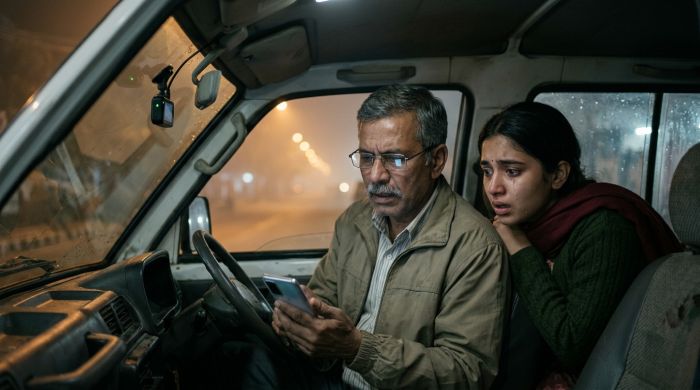
Inside the dimly lit cab, father and daughter leaned shoulder-to-shoulder over the six-inch screen.
Harishankar tapped into the folder marked DCIM / MOVIE and scrolled past afternoon files from Hazratganj, Indira Nagar, and Lohia Path until his thumb stopped on two consecutive three-minute clips:
20261120_183612.MP4 and 20261120_183912.MP4.
He tapped play.
At 18:36:12, the wide-angle lens showed the deserted rear service lane of Navrang Complex—dry leaves scraping across broken asphalt under a single orange sodium streetlamp, the metal basement shutter half-raised, nobody in sight.
Then, at 18:38:04, a white headlight beam swept around the corner from the Ring Road service lane.
It wasn't a heavy black motorcycle from a Noida courier office.
It was a silver Honda Activa scooter with a faded yellow coaching-institute sticker crooked across the front mudguard.
Harishankar paused the video and pinched the screen with two calloused thumbs to zoom in on the steel number plate glowing sharply in the dashcam's infrared bounce.
UP-32-KL-7294.
Nandini gasped so sharply her hand flew to her mouth. "Papa... that's Deepak Bhaiya's scooter! He got it second-hand from Nishatganj last year—that's the exact yellow sticker from his railway exam coaching!"
Harishankar didn't speak. His jaw felt carved out of granite as he pressed play again.
At 18:38:41, Deepak Mishra—Maheshwar's twenty-seven-year-old son, the nephew who had eaten Diwali sweets off Harishankar's plates three weeks ago—killed the scooter engine ten yards inside the gate, pulled off a blue woollen cap, and glanced nervously down the empty lane.
Four seconds later, a second figure stepped out from behind the brick transformer room beside the basement ramp.
He wasn't hiding his face at all, convinced the rear commercial lane was deserted after dusk.
Under the harsh orange streetlight, the dashcam captured him in unmistakable profile: a thick-set middle-aged man wearing a crisp brown Nehru jacket over a cream cotton kurta, holding a dark cloth shoulder bag in his left hand.
Maheshwar Mishra.
On the silent video screen, Maheshwar checked his wristwatch at 18:39:18—exactly the minute the first WhatsApp message had arrived on Nandini's phone in Aliganj—then unzipped his cloth shoulder bag, pulled out a black full-face motorcycle helmet, and handed it straight to Deepak.
Maheshwar tapped Deepak once firmly on the shoulder, pointed two fingers down the basement B2 ramp toward Pillar 14, and pulled out a slim black keypad phone to make a brief call before hurrying back toward the main Ring Road to catch an auto-rickshaw to Aliganj.
At 18:40:25, Deepak pulled the black helmet over his head, swung the scooter around to park inside the shadows behind the transformer box, and waited out of sight for Nandini to arrive.
Harishankar hit pause. The frozen image of Maheshwar's face under the sodium light burned quietly across the phone glass.
"He came straight from here to our dining table," Nandini whispered, her voice hollow with shock, as if the floor of her childhood had just cracked open. "He sat right across from Shashi Bua drinking ginger tea and eating biscuits while Deepak was waiting down there in the dark to rob us. Why, Papa? Why would Mama-ji do this to us?"
Harishankar slowly locked his phone screen and sat motionless for five full seconds, breathing steadily through his nose to keep his temper below the boiling point.
He knew why. Six months ago, a marble supplier from Kishangarh had come to Aliganj looking for Maheshwar over four lakhs in bounced post-dated cheques. Maheshwar had lied then, claiming it was a clerical dispute. He hadn't been helping Kamla's daughter out of love—he had been hunting for a quick three-lakh lifeline from the one quiet brother-in-law who never checked bank statements twice.
"Listen to me carefully, Nandu," Harishankar said, his voice remarkably calm as he started the Eeco van again. "We don't shout at him at home yet. If we scream without locking the bank and the police trail first, Deepak will shred your marksheets in a drain and drop that cheque into an outstation clearing box before sunrise."
He pulled out onto Kapoorthala Road, his mind working with the crisp, methodical clarity of a man who had spent thirty years handling cash ledgers and medical manifests.
First, he called his transport supervisor, Baldev Singh, on Bluetooth speakerphone and asked him to meet at the Aliganj SBI branch ATM lobby—no, even better, to stay ready as a witness confirming the dashcam's hardware timestamp and Harishankar's evening delivery challan at Dr. Saxena's clinic.
Second, at 9:06 PM, Harishankar pulled over under a bright streetlamp and dialed the State Bank of India 24x7 Positive Pay & Cheque Stop Helpline directly from his registered mobile number. After verifying his CIF number, Aadhaar last four digits, and the exact cheque leaf number 441809 from the stub booklet he always kept inside his van glovebox, he heard the crisp automated confirmation SMS chime into his inbox at 9:12 PM:
SBI Alert: Stop Payment registered for Cheque No. 441809 on A/C XX3108. Ref No. SP882941.
That killed the blank cheque before morning clearing.
Third, Harishankar turned the van straight onto Purania Road toward the Aliganj Police Station & Cyber Crime Help Desk.
He wasn't walking in as a stranger begging for an appointment. Eight months ago, during the September dengue surge, Harishankar had personally delivered emergency platelet cross-match kits at 1:30 AM without charging extra waiting fees for Sub-Inspector Raghvendra Verma's elderly mother at Vivekananda Polyclinic.
Within twelve minutes of reaching the Aliganj outpost, SI Verma—a lean, sharp-eyed forty-two-year-old officer in a navy police windcheater—sat at his corner desk watching the dashcam clip twice without interrupting once.
"Clean UP-32 plate, clear facial profile, time-stamped delivery challan across the street," SI Verma murmured, leaning back in his wooden chair as he examined Nandini's handwritten complaint and the screenshots of the ₹2,40,000 digital transfers. "Tiwari ji, the scooter and helmet are enough for Section 318 cheating and criminal conspiracy. But tell me about this Anjali Chauhan from Noida—did you ever see her face on video?"
"Never, Sir," Nandini replied quietly, sitting straight on the steel visitor chair beside her father. "Always audio calls or warm WhatsApp voice notes. She said she had glaucoma surgery and avoided camera glare."
SI Verma picked up his desk phone and called the Lucknow Cyber Cell nodal constable on night duty, reading out the UPI handle saraswatividya.csr@okaxis, the IMPS account number, and the secondary contact number Anjali Chauhan had used from the WhatsApp Business header.
For fifteen tense minutes, the only sound in the small tiled room was the ceiling fan creaking faintly overhead and a typewriter clacking in the duty clerk's bay.
Then SI Verma's monitor pinged with the NCRP banking-nodal KYC return.
The officer leaned forward, read three lines off his screen, and let out a low, disgusted breath.
"Tiwari ji," SI Verma said slowly, turning the monitor sideways so father and daughter could read the printed registration fields themselves. "There is no Noida charitable trust. There is no Anjali Chauhan."
Harishankar squinted through his spectacles at the screen.
Under Account Holder / KYC Proprietor for saraswatividya.csr@okaxis stood a sole-proprietorship current account opened four months ago at a private bank branch in Kakadeo, Kanpur.
The registered proprietor's name was Ritu Pandey—Maheshwar Mishra's twenty-nine-year-old married daughter.
And the secondary mobile number used for Anjali Chauhan's WhatsApp Business profile had its live KYC address and recent cell-tower log registered to Deepak Mishra, House No. 14/218, Sector 11, Indira Nagar, Lucknow.
Nandini gripped the edge of the steel chair so hard her knuckles turned white. "Ritu Didi... she called me on Rakhi to ask how my final exams went. She was the one recording those sweet voice notes pretending to be a Noida trustee!"
"They catfished both of you from inside your own family," SI Verma said grimly, immediately typing the frozen transaction reference numbers into the National Cyber Crime Reporting Portal (1930) lien module. "They knew you'd never lend three lakhs to Maheshwar Mishra directly after his marble business tanked. So father, son, and married daughter built a fake Noida CSR profile using a stolen LinkedIn photo of a retired Pune professor, split the roles, and waited for tonight's blank cheque to wipe out the rest before staging a fake robbery scare."
Two minutes later, the nodal officer confirmed via return call: ₹1,78,000 was still sitting inside Ritu Pandey's Kanpur current account—and an immediate debit-freeze lien had just locked every single paisa before anyone could transfer it out at midnight.
SI Verma stood up and buttoned his windcheater. "We're going to your house right now with two constables in a private Bolero. Don't warn them on the phone. Let Maheshwar Mishra finish telling his bedtime story at your dining table first."
The wall clock in the Aliganj dining room read 10:24 PM when Harishankar pushed the front door open once more.
Shashi Bua was pacing near the kitchen doorway with worry lines carved deep around her mouth, while Maheshwar sat in the exact same corner chair at the wooden dining table—his brown Nehru jacket still buttoned neatly over his cream kurta, a fresh plate of untouched biscuits resting beside his elbow.
The moment Nandini stepped across the threshold behind her father in Harishankar's oversized navy windbreaker, Shashi let out a sharp sob of relief and rushed forward to hug her niece.
Maheshwar rose slowly to his feet, putting on a masterclass in wounded concern. "Nandu! Harry! Where on earth did you vanish for two hours? Look how pale she looks! I've been calling Anjali madam nonstop since eight-thirty—she just texted me back ten minutes ago saying her Lucknow courier waited outside Navrang Complex until eight and left empty-handed because Nandu never turned up!"
Silence hung heavy in the small room.
Shashi looked toward Harishankar, confused. "Never turned up? Then where did you find her, Harry?"
Harishankar didn't raise his voice. He didn't slam a fist onto the wood or curse a single word.
He walked calmly over to the teakwood dining table, picked up Nandini's dark-blue Vivo phone from beside the sugar jar, and set his own Samsung phone face-up right in the center of the table—between the cold casserole of dal-tadka and Maheshwar's teacup.
"That's funny, Maheshwar bhaiya," Harishankar said quietly, his voice level and unhurried. "Because my daughter waited at Pillar 14 from 7:15 PM until a man on a motorcycle in a black full-face helmet took her original marksheets and my signed SBI cheque at 7:22 PM."
Maheshwar's smile froze for half a second before he recovered with practiced indignation. "What nonsense! Then someone intercepted her outside! How could Anjali madam's man—"
"Before you call anyone else," Harishankar cut in softly, pressing his thumb against the Samsung screen, "look at what was sitting inside that empty Navrang Complex gate at 6:38 PM while I was parked across the lane waiting for Dr. Saxena's lab challan."
He turned the phone slightly toward Maheshwar and Shashi and tapped play.
The bright screen glowed across the dim dining room.
First came the empty asphalt lane. Then the silver Honda Activa gliding in with the crooked yellow coaching sticker and glowing plate UP-32-KL-7294. Then Deepak stepping off the scooter—and four seconds later, Maheshwar himself stepping out from behind the transformer room in the exact brown Nehru jacket he was still wearing at the dining table, handing his son a black full-face helmet from his cloth bag.
Shashi Bua's hand flew to her throat. Her eyes darted wildly from the brightly lit screen to Maheshwar's brown jacket, then back again.
"Maheshwar..." Shashi breathed, backing away a step as if the air around him had turned sour. "You told me you came straight from Nishatganj by auto at seven! That's Deepak's scooter! What were you doing handing Deepak a helmet at six-forty?!"
The blood drained completely from Maheshwar's face, leaving his cheeks grey beneath the white tube light. His right hand brushed involuntarily against the pocket of his Nehru jacket as if checking whether the cloth bag was still hidden.
"This—this is edited," Maheshwar stammered, his smooth patriarch's voice cracking down an octave. "Or—or I only met Deepak there to collect fifty rupees he owed me! That doesn't prove anything about any Noida trust!"
"Actually, it doesn't have to," Nandini spoke up firmly, stepping beside her father and placing three crisp, warm printouts from the Aliganj Cyber Desk squarely atop the yellow sticky note she had left earlier. "Here is the SBI Stop Payment receipt for Cheque 441809, placed at 9:12 PM. Here is the NCRP freeze order locking ₹1,78,000 in Kakadeo, Kanpur. And here is the bank KYC sheet showing that Mrs. Anjali Chauhan's corporate UPI handle belongs to Ritu Didi—and the WhatsApp SIM belongs to Deepak's flat in Indira Nagar."
Maheshwar stared at his daughter Ritu's name printed in stark black ink across the official police printout. His knees buckled slightly against the back of the wooden chair, and he sat down heavily without meaning to.
Just then, a firm knock sounded against the open verandah grill.
Sub-Inspector Raghvendra Verma stepped cleanly into the doorway with one uniformed constable visible behind him near the gate, while Harishankar's transport supervisor Baldev Singh stood calmly by the scooter porch.
"Maheshwar Mishra?" SI Verma asked evenly, holding out the stamped FIR copy under BNS Section 318(4) and Section 66D of the IT Act. "Our team is already outside House 14/218 in Indira Nagar. Either you call your son right now to surrender the girl's original B.Sc. certificates and the cancelled cheque leaf cleanly within twenty minutes, or both father and son spend tonight in the Aliganj lockup while Kanpur police serve an arrest memo on your daughter Ritu."
The dignified, booming uncle who had lectured Harishankar about family honor vanished in less than ten seconds.
Maheshwar leaned forward over the cold dal casserole, buried his face in both hands, and began sobbing raggedly—begging Harishankar not to let police vans pull up outside Ritu's in-laws' house in Kanpur.
"Look at Kamla's photograph on the wall before you beg me," Harishankar said quietly, nodding toward the framed garlanded picture above the sideboard. "She trusted you as her elder brother. You watched me drive twelve hours a day in winter rain and still planned to take the last gold off her wrists."
Maheshwar couldn't lift his head to look at his dead sister's picture.
By 11:15 PM, after two shaking phone calls made on speakerphone in front of SI Verma, a terrified Deepak arrived outside the Aliganj police outpost on that same silver Honda Activa, handed over Nandini's unharmed cloth folder with every original certificate inside plus Harishankar's blank SBI cheque leaf, and surrendered his secondary phone for forensic seizure.
The next morning, Maheshwar's stunned elder brother from Barabanki and Ritu's furious father-in-law sat inside the Aliganj chowki mediating in humiliated silence. Under a formal police-witnessed recovery memo and bank restitution undertaking, Maheshwar's family deposited the remaining ₹1,42,000 (covering the ₹62,000 already spent from the Kanpur account plus the cash ₹80,000 Maheshwar had pocketed) directly back into Harishankar's SBI account via RTGS—alongside the ₹1,78,000 released under court-verified cyber-fraud refund order ten days later.
Harishankar didn't forgive Maheshwar with cheap smiles, and he didn't invite him back inside the Aliganj flat. He simply signed the restitution acknowledgment so his own sister Shashi wouldn't carry the lifelong grief of watching her late sister-in-law's niece go to jail—and closed his front gate permanently to men who measured family loyalty by how easily a widower could be fooled.
The following Tuesday afternoon, Harishankar parked his white Maruti Eeco neatly outside the Muthoot Finance branch near Kapoorthala—the same pavement where he had stood ten days earlier feeling ten years older than his age.
He didn't take anyone with him for moral support this time. He walked in alone in his washed khaki jacket, paid off the principal and ten days' interest cleanly at the counter, and waited while the branch manager retrieved the small sealed red velvet pouch from the vault.
When the clerk placed Kamla's two 22-karat bangles on the rubber mat—38.4 grams, gleaming softly beneath the bright office tube lights—Harishankar didn't feel triumphant. He felt a deep, settling peace settle straight into his chest.
Back in Aliganj that evening, he locked the red velvet pouch safely inside the top steel locker of Nandini's almirah and handed her the duplicate key.
Nandini never applied through a private trust or a backdoor uncle's contact again.
Two weeks later, carrying her own pristine folder of original marksheets, she boarded an early morning UPSRTC Janrath bus to sit for a direct university interview at the State Clinical Research & Diagnostic Fellowship Wing attached to King George's Medical University—no middlemen, no secret escrow deposits, no phone-free basements.
She didn't get an eight-lakh handout. She earned something infinitely cleaner: a verified merit placement right in Lucknow with an eighteen-thousand-rupee monthly research stipend, paired with a transparent SBI Scholar Education Loan sanctioned cleanly across a public bank desk at eight-point-fifteen percent interest, with zero collateral up to four lakhs.
The first Sunday morning of December dawned crisp and sunlit across Aliganj Sector-H.
Harishankar sat at that same four-seater teakwood dining table in a clean light-blue cotton kurta, reading the morning Hindi daily without hurrying for a 5:30 AM dispatch.
Shashi Bua walked in from the kitchen carrying a steaming steel plate of hot besan jalebis she had picked up from Kapoorthala stall, setting them carefully beside two steel tumblers of ginger-cardamom chai.
"Eat while they're crisp, Harry," Shashi murmured, her eyes still slightly glistening whenever she looked at her younger brother—quietly proud of the gentle, stubborn man who had protected his daughter without once losing his dignity. "You haven't had a proper Sunday breakfast since October."
Nandini slid into the chair across from him, tying her hair back with a blue ribbon, her Vivo smartphone lying openly beside her plate with nothing hidden on its screen. "Papa, Baldev Uncle called while you were bathing. He said two new pathology chains in Gomti Nagar want a dedicated morning route from January—extra six thousand a month if you want it, or he'll give it to another driver."
Harishankar picked up a warm jalebi, broke off a small piece, and looked out through the barred front window toward the dusty lane where his white Maruti Eeco van sat washed and gleaming in the winter sun.
He was fifty-five years old. He had no billionaire friends, no hidden inheritance, and no shortcuts left to believe in—just two steady hands, a clean ledger at the bank, and a daughter who would walk into a research lab on Monday morning with her head held high.
"Tell Baldev I'll take the Gomti Nagar morning route," Harishankar smiled, lifting his steel tumbler of hot chai. "After all, I already know every basement ramp there by heart."