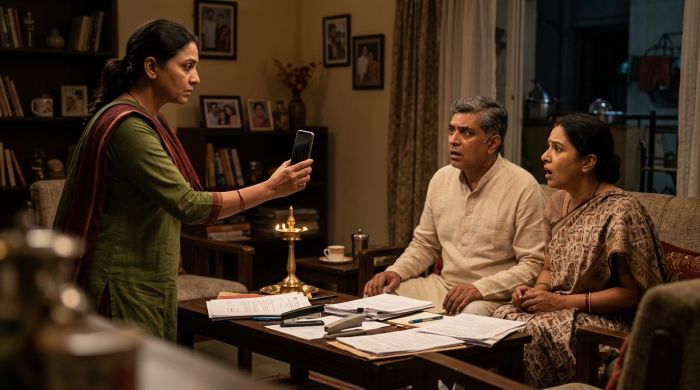
The copper kalash had not even been lifted from the center table when Rajesh Kulkarni slid the stamped green bond paper across the rosewood surface.
Meenakshi stood beside the kitchen doorway with a steel tray of cardamom tea in her hands. Outside the third-floor balcony of Gulmohar Apartments in Kothrud, Pune, the late afternoon sun filtered through neem leaves, casting long shadows across the white cotton sheets spread over the living room floor for their mother's thirteenth-day Terahvi prayer gathering.
Three aunts from Satara sat along the sofa, their silk pallus draped neatly over their shoulders. Uncle Madhav—their mother's younger brother—was still folding his spectacles into their leather case after the priest's final chant.
Nobody had expected business papers before the marigold garlands were even taken down from Vasudha Kulkarni's framed photograph.
"Meenu, keep the tray down and sit for two minutes," Rajesh said, his voice carrying the crisp, practiced smoothness of a man who spent twenty years managing regional sales teams in Bengaluru. "Before everyone leaves for the station, it's better we clear the flat's paperwork openly."
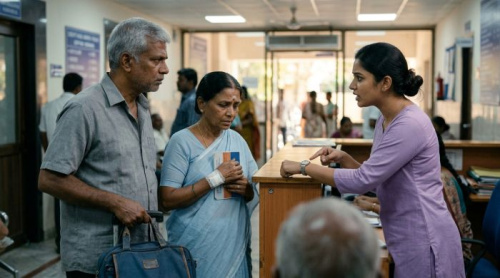
Meenakshi set the steel tray on the dining sideboard. At forty-nine, her dark hair was streaked with silver at the temples, tied back in a loose, tired knot. She had spent the last eleven years in a faded handloom salwar kameez, balancing evening shifts at the Sahyadri Charitable Hospital outpatient desk with round-the-clock care for a diabetic, wheelchair-bound mother.
"What paperwork, Dada?" she asked quietly.
Rajesh tapped the green stamp paper with two fingers. "Aai registered a Gift Deed in my name on October 4th at the Shivajinagar Sub-Registrar's office. She wanted the Kothrud flat settled cleanly so there wouldn't be any court delays after her passing."
The room went so still that the ceiling fan's faint click sounded like a metronome.
Uncle Madhav frowned, pulling his spectacles back out. "October 4th? Rajesh, Vasudha couldn't even walk from her bedroom to the bathroom without Meenakshi's shoulder under her arm since January. How did she climb the stairs at Shivajinagar?"
"We arranged a ground-floor wheelchair token through Advocate Milind," Rajesh replied smoothly, not blinking once. "And frankly, Mama, Aai felt Meenu had already sacrificed enough of her own life here. I've spoken to a builder from Karve Nagar who wants to redevelop the corner wing. He's offered one crore forty-five lakhs for an outright transfer."
Meenakshi's fingers curled around the edge of the dining chair. "Dada... Aai never told me she was gifting the flat."
"She didn't want you getting emotional and refusing," her younger sister Kavita chimed in from the armchair, adjusting her heavy gold bangles with an apologetic sigh that didn't reach her eyes. "Honestly, Meenu, you've lived rent-free here for eleven years while Rajesh and I handled our own households. Aai told me on the phone last month that she wanted Rajesh to sell the flat, give you five lakhs for a modest one-room rental deposit in Warje, and divide the rest between the two of us who have children's college fees to pay."
Five lakhs. And fifteen days to pack eleven years of hospital rosters, her father's old Marathi library, and the narrow wooden cot she had slept on beside her mother's bed so she could hear every cough in the night.
"Fifteen days," Meenakshi repeated, her voice barely above a whisper. "You're asking me to vacate Aai's home in fifteen days?"
"The builder's earnest cheque clears on the first of next month," Rajesh said, sliding a second sheet—a typed notice drafted on Advocate Milind's letterhead—next to the Gift Deed. "Sign the acknowledgment today while Mama and the aunts are witnesses. Let's not turn a respectable family into a bazaar spectacle."
Meenakshi looked at the stamped paper. She looked at the date printed in bold black ink near the top margin: 04/10/2026 — 11:42 AM.
Something cold and sharp clicked behind her ribs.
On October 4th, Rajesh had sworn in the family WhatsApp group that he was in Hyderabad for a four-day pharmaceutical conference. And Kavita had sent photos of Durga Puja pandals in Nashik.
More importantly, on the morning of October 4th, Meenakshi had left the flat at 10:15 AM for only forty minutes—to collect Vasudha's monthly insulin pens from the Sahyadri Charitable Hospital pharmacy—leaving their mother asleep under the care of Sunita, the part-time maid who arrived at ten.
Except Sunita had taken sick leave that morning.
And when Meenakshi returned at 11:05 AM, her mother was still fast asleep in her cotton nightgown, breathing evenly, her swollen knees wrapped in warm flannel.
"I'm not signing anything today," Meenakshi said, her voice steadier than she expected.
Rajesh's polite mask slipped by a fraction of an inch. "Meenu, don't be stubborn. It's a registered government document with Aai's Aadhaar thumbprint and photograph. If you force me to send a legal bailiff through the society chairman, it will embarrass you in front of the entire building."
He stood up, slipped the original deed back into his leather folder, and left the typed vacate notice sitting on the center table like a stone.
That night, after the last relative boarded the evening train back to Satara, the two-bedroom flat felt larger and colder than it had in eleven years.
Meenakshi did not sleep. She sat on the edge of her mother's empty hospital-style bed, staring at the brass railing she had wiped down with Dettol every morning before leaving for work.
People who only visited once a year at Diwali never knew what eleven years of caregiving actually smelled like. It smelled of eucalyptus balm, boiled moong dal, damp monsoon bedsheets, and the faint antiseptic tang she carried home on her dupatta from Sahyadri Hospital.
When her father, Prabhakar Kulkarni, had suffered a fatal heart attack eleven years ago at sixty-six, he had left behind this modest Kothrud flat, a small fixed deposit of four lakhs, and a quiet request in Meenakshi's palm: Take care of your mother, Meenu. Your brother has his ambitions, and Kavita has her new home.
She had never complained. When a decent marriage proposal came from a bank clerk in Solapur six months after her father died, and the boy's parents insisted she move to Solapur without her mother, Meenakshi had served them tea, folded her hands, and said no.
She had watched her friends' children graduate, buy scooters, and get married while she spent her Sundays queuing at the municipal dispensary and arguing with insurance clerks over Vasudha's cataract surgery.
Her monthly salary at Sahyadri Charitable Hospital was thirty-four thousand rupees. Every month, eighteen thousand went straight into Vasudha's physiotherapy, adult diapers, blood sugar strips, and cardiac tablets. Whenever Meenakshi fell short at the end of the month, she picked up extra Sunday registration shifts or skipped buying new footwear for another year.
Rajesh sent a fruit basket on Mother's Day and transferred ten thousand rupees twice a year—always making sure to post the UPI screenshot in the family WhatsApp group with a caption like, Little contribution for Aai's medicines, Meenu. Let me know if you ever need anything else.
Whenever she actually asked him to stay for one weekend so she could attend a cousin's wedding or rest a sprained ankle, Rajesh always had a quarterly audit in Chennai or his son's coaching exams in Bengaluru.
And Kavita—whose husband owned two thriving hardware showrooms in Nashik—brought expensive Kanjeevaram saris for Vasudha on Dussehra that a bedridden woman could never wear, then left after three hours because the guest bedroom didn't have split air-conditioning.
Yet when Vasudha's blood pressure crashed at two in the morning during the July floods, it wasn't Rajesh or Kavita who carried her down three flights of stairs with the building watchman in pouring rain. It was Meenakshi.
She remembered that night in vivid, aching detail. The ambulance couldn't enter the waterlogged lane off Paud Road, so Meenakshi had held a broken umbrella over her mother's trembling shoulders while Subhash Kaka and the watchman lifted the plastic chair down the dark stairwell step by wet step. At Sahyadri Hospital, where she usually sat behind the glass reception desk handing out token slips, she had sat on the cold steel bench outside the ICU for thirty-six hours in the same damp cotton kurta.
When Vasudha finally opened her eyes on the third morning, she couldn't speak clearly because of the mild stroke, but her left hand had reached out blindly until her fingers found Meenakshi's wrist. She had held on so tightly that the duty nurse had to gently pry her fingers loose just to check her blood pressure cuff.
"Don't leave me with them, Meenu," Vasudha had whispered later that week when her speech returned, thick and slurred. "They talk about me like I'm an old cupboard taking up space in the hall."
Meenakshi had smoothed her mother's silver hair, swallowed the lump in her throat, and promised, "I'm not going anywhere, Aai. This is your home for as long as you breathe."
In the two years after the stroke, Meenakshi's entire world shrank to a three-kilometer radius between Flat 301 and Sahyadri Hospital. She learned how to lift a seventy-kilogram woman onto a bedside commode without straining her own lower back. She learned how to crush blood-pressure tablets into warm water, how to spot the earliest sign of a urinary infection before fever set in, and how to smile politely at patients yelling at the hospital counter at eight in the evening even when her own feet were swollen inside worn leather chappals.
Her colleagues at the hospital—especially senior clerk Sunanda Tai—often tucked extra tiffin boxes of poha or sabudana khichdi into Meenakshi's bag because they knew she hadn't had time to cook lunch for herself. Twice, when Vasudha's sugar dropped dangerously low at noon, Sunanda Tai covered the reception desk for two hours without telling the HR supervisor.
Meanwhile, Rajesh's family visited Pune once in twenty-four months—for eighteen hours on their way to a resort in Mahabaleshwar. His teenage son complained that the flat didn't have high-speed Wi-Fi, and Rajesh's wife spent most of the evening on the balcony taking work calls before reminding Meenakshi not to forget to pay the society maintenance cheque on time.
Yet Meenakshi had never asked for a single paisa of credit. She had believed, with the quiet stubbornness of an Indian daughter raised to keep peace at any cost, that love was measured in presence, not paperwork.
Now, sitting beside that silent bed, Meenakshi picked up the typed eviction notice from the table.
04/10/2026 — 11:42 AM.
How could a woman who couldn't sit upright in a rickshaw without groaning in pain have gone to the Shivajinagar Sub-Registrar's office at 11:42 AM on a Tuesday morning, posed for a webcam photo, pressed her thumb onto a biometric scanner, and signed a Gift Deed—all while Meenakshi was only gone for fifty minutes?
She couldn't have.
Which meant someone had walked into that government office pretending to be Vasudha Kulkarni.
At seven the next morning, Meenakshi didn't call Rajesh, and she didn't call a lawyer she couldn't afford. Instead, she walked across the narrow third-floor landing and rang the bell of Flat 302.
Subhash Deshmukh opened the door wearing a faded railway-union sweater over his kurta, holding his morning copy of Sakal. At sixty-six, the retired senior section engineer had been Vasudha's neighbor for twenty-eight years—the man who used to fix Prabhakar's leaky kitchen tap and quietly drop off fresh papayas from his sister's farm in Baramati.
"Meenu? Come in, beta," Subhash Kaka said, his expression softening immediately as he noticed the dark hollows under her eyes. "I saw the relatives leaving last night. Is everything all right?"
"Kaka, I need to ask you a strange question," Meenakshi said, stepping just inside the foyer and holding up the copy of Rajesh's Gift Deed. "You installed that white camera doorbell above your name plate in July, right? After someone stole your courier packages?"
Subhash Kaka adjusted his glasses and looked at her sharply. "Yes. The Wi-Fi camera covers the entire third-floor staircase landing and your front door. Why?"
"Does it still have recordings from October 4th?" Meenakshi asked, her heart thudding against her ribs. "Between ten in the morning and noon?"
Subhash Kaka didn't ask for gossip. He walked straight to his study desk, opened his tablet, and tapped into the cloud storage app. "I pay three hundred rupees a month for the ninety-day cloud backup ever since the society treasurer lost his scooter helmet. Let's check October 4th."
He scrolled back through the calendar dates. October 4. Tuesday.
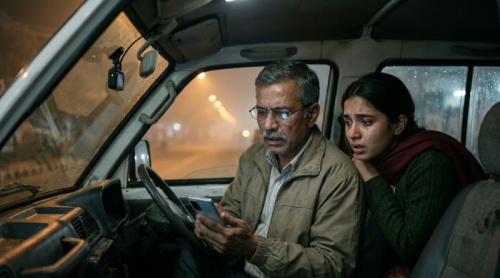
At 10:16:08 AM, the motion clip showed Meenakshi locking her front door in a blue cotton dupatta, carrying her cloth pharmacy bag down the stairs.
"That's me leaving for Sahyadri Hospital," Meenakshi whispered.
Subhash Kaka tapped the next motion alert. 10:41:22 AM.
Both of them leaned closer to the tablet screen.
Up the staircase came Kavita—wearing a bright mustard-yellow silk sari and sunglasses pushed up into her hair—even though she had posted photos from Nashik that exact afternoon. Behind her walked an elderly woman of roughly Vasudha's height and build, wearing a pale green cotton sari and a thick woollen shawl pulled tightly around her cheeks and chin, walking briskly up the steps on her own two feet.
Beside them was Advocate Milind—Rajesh's brother-in-law's college friend from Pimpri—carrying a thick brown leather briefcase.
Meenakshi's hand flew to her mouth.
"Look at her ankles," Subhash Kaka said softly, zooming in with two fingers. "Your mother's feet were always swollen from kidney retention, Meenu. She wore flat Velcro orthopedic sandals. This woman is walking up the third floor in regular leather chappals without holding the railing."
On the screen, Kavita didn't even ring the doorbell of Flat 301. She pulled a duplicate brass key out of her handbag, unlocked Meenakshi's front door, and ushered the unknown woman and Advocate Milind inside.
Four minutes later, at 10:45:50 AM, they walked back out. The unknown woman was now carrying Vasudha's familiar grey Kashmiri shawl—the one Vasudha always wore in photos—and holding a folded Aadhaar folder in her left hand. Kavita locked the door quietly from the outside, glanced once toward the stairs, and all three hurried downward.
They never took Vasudha out of the flat. They had only slipped inside to fetch Vasudha's original shawl, her old laminated Aadhaar card from the bedside drawer, and wait for the cab waiting on Paud Road.
At 11:04:12 AM, the next clip showed Meenakshi returning up the stairs with her cloth bag of insulin pens, completely unaware that six minutes earlier, a stranger wearing her mother's shawl had been driven straight toward the Shivajinagar Sub-Registrar's office.
"She didn't even wake Aai up," Meenakshi breathed, tears of cold anger stinging her eyes. "Aai was sleeping inside the back bedroom with the fan on. They used a duplicate key."
Subhash Kaka's jaw tightened. "Export both clips to your phone right now, Meenu. And don't tell your brother a single word yet."
He poured two small steel glasses of hot filter coffee from his kitchen flask and placed one gently in Meenakshi's cold hands. His own two sons lived in Dallas and Frankfurt—good boys who called every Sunday on video, yet Subhash Kaka knew better than anyone in Gulmohar Apartments what it meant to grow old in a three-room flat with only a neighbor to notice if your milk packet was still hanging on the door hook at nine in the morning.
"Listen to me carefully, beta," Subhash Kaka said, lowering his voice. "When my wife passed away four years ago, a distant cousin tried to claim half of my ancestral plot in Satara using a photocopied power of attorney. Good people lose their homes because they feel ashamed to make a scene in front of relatives. Your brother is counting on your decency. He thinks a hospital receptionist who never raised her voice in forty-nine years will quietly pack her trunk and walk away to avoid society gossip."
Meenakshi looked down at the dark coffee swirling in the steel tumbler. For the first time since yesterday afternoon, the numbness in her chest gave way to something sharp, clear, and steadying.
"He didn't just try to take the flat, Kaka," she said softly. "He used Aai's illness against her while she was asleep in the next room. I won't let them erase eleven years of her life like she was a signature on a receipt."
"Good," Subhash Kaka nodded, pulling a small blue diary from his desk drawer. "Before you go to the registrar's office, stop by the society watchman's cabin downstairs and take a photo of the October 4th visitor register. The night guard, Ramesh, never lets an outsider up without writing down their bike or car number. If Advocate Milind came with a strange woman, Ramesh wrote something down."
At nine o'clock that morning, Meenakshi called the Sahyadri Charitable Hospital superintendent, Dr. Kulkarni—no relation, just a kind sixty-year-old physician who had watched Meenakshi work the outpatient counter for twelve years without taking a single sick day.
She requested three days of earned leave and asked for one specific record from the hospital's home-care wing: the signed visit log and biometric attendance sheet of Prashant, the hospital's senior physiotherapist, who visited Vasudha at home every Tuesday and Friday morning at 9:30 AM.
"October 4th was a Tuesday," Dr. Kulkarni confirmed, pulling up the digital tablet log in his office. "Prashant logged a forty-five-minute session at Flat 301 from 9:32 AM to 10:17 AM. His clinical note explicitly states: Patient Vasudha Kulkarni unable to bear weight on left knee; severe pedal edema; advised strict bed rest, zero stair climbing. I'll sign and stamp a certified medical extract for you right now, Meenakshi."
With the medical certificate, Subhash Kaka's exported video clips, and the Gulmohar Apartments watchman's visitor register—which clearly showed Advocate Milind signing in under a fake flat number at 10:38 AM—Meenakshi took an auto-rickshaw to the Shivajinagar Sub-Registrar's Office.
She didn't go to fight at the public counter. She walked straight up to the District Registrar's Vigilance & Grievance Desk on the second floor and asked for a certified copy of the October 4th Gift Deed under the Right to Information and Document Inspection rules.
When the clerk printed the archived registration sheet—complete with the webcam photo captured at 11:42 AM—Meenakshi felt the last piece of the puzzle lock into place.
The woman sitting in front of the Sub-Registrar's webcam was wearing Vasudha's grey Kashmiri shawl pulled slightly across her forehead. Her face was rounder than Vasudha's, her nose broader—it was Sulochana Mami, Rajesh's mother-in-law's widowed cousin from Barshi, whom Vasudha hadn't spoken to in eight years!
And how had they bypassed the Aadhaar fingerprint match?
Right beside the thumbprint box, the registration sheet carried a handwritten clerk's stamp: Biometric OTP bypass approved — senior citizen worn ridges — verified via registered mobile OTP.
Meenakshi's stomach turned cold. Two weeks before her mother died, Rajesh had insisted on "upgrading" Vasudha's old Jio SIM card to a postpaid family plan linked to his Bengaluru email and secondary OTP number—claiming it would save Meenakshi the hassle of recharging it every month.
He hadn't been helping her with phone bills. He had been hijacking the Aadhaar OTP line so he could bypass a dead-tired old woman's thumbprint at a corrupt counter.
"Madam," the vigilance officer said quietly after comparing the hospital's October 4th mobility certificate against the webcam photograph and Subhash Kaka's doorbell video, "this is prima facie impersonation under Section 82 of the Registration Act and cheating under the Bharatiya Nyaya Sanhita. If you file a formal objection today, we freeze the property mutation immediately and issue a show-cause notice to the presenting advocate and witnesses."
"File it," Meenakshi said without hesitation. "And please give me the stamped freeze acknowledgment today."
The vigilance officer typed out the preliminary diary entry on his terminal, stamped two copies of the freeze acknowledgment in bright crimson ink, and handed one across the counter. "One more thing, Mrs. Kulkarni," he added, glancing over his reading glasses. "Under the new e-registration protocol, a copy of this show-cause notice goes automatically to the Pune Bar Council's disciplinary cell if the presenting advocate cannot produce the executant's live hospital fitness certificate. Usually, when brokers and relatives realize a vigilance file has been opened, they run to cancel the deed before the police FIR is numbered."
Meenakshi folded the crimson-stamped paper carefully into her cloth handbag. As she stepped out of the Shivajinagar office into the noisy midday traffic of Jangli Maharaj Road, she didn't feel triumphant. She felt an odd, quiet sorrow—not for herself, but for the brother and sister who had traded thirty years of childhood memories on that Kothrud terrace for a few dozen lakhs of builder money.
She stopped briefly at a small Udupi eatery near Goodluck Chowk because she realized she hadn't eaten since seven that morning. Sitting alone at a marble-topped table with a plate of warm idli-sambar, she watched office workers, college students, and elderly retired couples walking past the rain-washed banyan trees outside. For eleven years, every meal outside her apartment had felt like stolen time; every extra half-hour away from Flat 301 had carried a quiet stab of guilt. Now, for the first time, she understood that defending her mother's dignity was not selfishness—it was the last promise she owed Vasudha.
Meenakshi did not wait fifteen days, and she did not hire a high-priced lawyer.
Instead, she sent a single polite message in the family WhatsApp group on Saturday afternoon:
Dada and Kavita, Uncle Madhav and the housing society chairman are coming over tomorrow at 11:00 AM for the final charity donation and flat handover discussion. Please be present so everything is settled in front of our elders.
Rajesh arrived at 10:50 AM on Sunday in a crisp white linen kurta, looking smug and relieved—convinced his quiet, exhausted sister had finally accepted her five-lakh payout and was ready to hand over the keys.
Kavita walked in five minutes later with her husband, carrying an empty cardboard carton as if she were already sizing up which brass lamps and silver puja plates to pack into her SUV.
Wait—not everyone they expected was there. Sitting calmly on the sofa beside Uncle Madhav were Subhash Kaka, the housing society chairman Mr. Patwardhan, and Advocate Deshpande, a retired legal advisor who lived on the first floor.
Rajesh's smile faltered for half a second when he saw Mr. Patwardhan holding the society's bound gate register, then he recovered smoothly. "Good, Chairman sir is here too. That makes the NOC transfer faster. Meenu, have you packed your things? The builder's representative is waiting downstairs."
"Before we call the builder," Meenakshi said evenly, placing a slim folder on the rosewood table right next to Rajesh's eviction notice, "there's one small correction we need to make to the October 4th date."
Kavita stiffened slightly. "What correction? The date is printed by the government computer."
"Exactly," Meenakshi said. She unlocked her smartphone, set it upright against the brass candle holder in the center of the table, and pressed play.
Subhash Kaka's crisp HD doorbell audio filled the quiet living room.
On the bright screen, at 10:41:22 AM on October 4th, Kavita walked straight up the third-floor landing in her mustard-yellow silk sari—the exact day she claimed she was in Nashik—unlocked Flat 301 with a duplicate key, and hurried out four minutes later with a strange woman carrying Vasudha's grey Kashmiri shawl.
The color drained completely from Kavita's face. Her husband stood up from the sofa so fast his teacup rattled on the saucer. "Kavita... what is this? You told me you went to Trimbakeshwar temple with your sister-in-law that morning!"
"It—it's just a video of me visiting Aai!" Kavita stammered, her gold bangles clattering against each other as she tried to reach for the phone. "What does that prove?"
"It proves you lied about being in Nashik," Uncle Madhav thundered, his face darkening with shock and disgust. "And look at the woman beside you—that isn't my sister Vasudha! Vasudha couldn't stand on her own two feet!"
Rajesh stepped forward, trying to salvage his authority with sheer volume. "This is ridiculous! Maybe Aai went down through the back lift earlier—"
"Gulmohar Apartments doesn't have a back lift, Rajesh," Mr. Patwardhan cut in coldly, tapping the open gate register. "And at 9:32 AM that same morning, Sahyadri Hospital's physiotherapist signed in at the gate. Here is Dr. Kulkarni's stamped clinical extract confirming Vasudha was bed-bound with severe pedal edema at 10:17 AM."
Meenakshi slid the final sheet across the table—the District Registrar's crimson-stamped Freeze Order and Show-Cause Notice, along with a printed copy of the Shivajinagar webcam photo showing Sulochana Mami's face wrapped in Vasudha's shawl, and the Aadhaar SIM OTP transfer log tied directly to Rajesh's Bengaluru email.
"The builder downstairs can go home," Meenakshi said quietly, her voice steady without ever rising to a shout. "The District Registrar froze the Gift Deed yesterday afternoon under Section 82. A criminal impersonation notice has already been dispatched to Advocate Milind and to Sulochana Mami in Barshi."
Rajesh stared at the crimson stamp as if the floor beneath his leather sandals had vanished. For the first time in his life, there was no regional sales target to spin, no family WhatsApp group to impress.
"Meenu..." he swallowed hard, his voice cracking. "Wait. Don't let this go to the police. Think of my job in Bengaluru. Think of the family name."
"Did you think of the family name when you gave me fifteen days to leave the home I spent eleven years nursing Aai in?" Meenakshi asked softly.
"Aai left a genuine registered will in her Bank of Maharashtra locker back in 2019," Uncle Madhav spoke up, pulling a sealed bank acknowledgment slip from his own kurta pocket. "She made me the co-nominee six years ago because she told me privately: Rajesh and Kavita love what I own; only Meenu loves who I am. She left the Kothrud flat solely to Meenakshi, and split her four-lakh fixed deposit equally—except neither of you bothered to ask about her locker because you assumed you could grab the flat before anyone checked."
Kavita sank back onto the armchair, covering her face with both hands as her husband glared at her in humiliated silence and walked straight out the front door without saying goodbye to anyone.
Rajesh stood frozen for three long seconds, then reached for his leather folder. "I'll... I'll withdraw the Gift Deed tomorrow morning. Just drop the vigilance complaint, Meenu. Please."
"I won't send my own brother to jail if you sign the cancellation affidavit at Shivajinagar tomorrow at ten in front of Advocate Deshpande," Meenakshi replied, looking him straight in the eye. "And you will never set foot in this building to threaten me again."
After Rajesh and Kavita left, Uncle Madhav stayed back for an extra twenty minutes in the quiet living room. The older man sat heavily on the sofa, his shoulders slumped as he looked at Vasudha's garlanded portrait on the wall.
"I should have come by more often, Meenu," Uncle Madhav said softly, his voice thick with regret. "I saw your brother's big car and Kavita's gold bangles and assumed you were all sharing the load. None of us ever asked how you managed a thirty-four-thousand-rupee salary with ICU bills and insulin." Meenakshi simply poured him a fresh cup of tea and touched his feet as he blessed her—knowing that even late recognition from an elder could still mend a bruised heart.
On Monday morning at ten sharp, Rajesh signed the deed cancellation in silence, his head bowed beneath the fluorescent lights of the same Shivajinagar hall where he had tried to erase his sister's eleven years of devotion. Advocate Milind surrendered his copy of the duplicate key to Mr. Patwardhan without meeting anyone's eyes.
When Meenakshi returned to Flat 301 that afternoon, the house was quiet—not the suffocating silence of grief or fear, but the clean, peaceful quiet of a home that finally belonged to the person who had kept it warm.
She opened the balcony doors to let the crisp Pune breeze sweep through the living room, watered the tulsi plant in the brass pot her mother had tended every morning before her knees gave out, and sat down with a fresh cup of masala chai.
For the first time in eleven years, she didn't have to apologize for taking up space in her own life. She kept her job at Sahyadri Charitable Hospital—not out of desperation anymore, but because she loved her patients—and used a small portion of her mother's bank deposit to finally take a solo train trip to Konkan she had postponed since her thirties. Sitting by the open window of the Konkan Kanya Express as red laterite hills and coconut groves rolled past beneath a clear winter sky, she let the salt air dry the last traces of eleven years of exhaustion. She walked barefoot along the quiet Dapoli shore at sunset, bought fresh Alphonso mangoes and kokum syrup for Subhash Kaka and Sunanda Tai, and realized she was only forty-nine—still young enough to build a gentle, unhurried life of her own. When she returned to Pune on Sunday night, the watchman carried her small suitcase up to the third floor with a warm smile, and Subhash Kaka was already waiting by the landing with two steaming cups of ginger tea to hear every detail of the sea.
Across Pune and every quiet neighborhood like Kothrud, families rarely break apart over strangers; they break when lifelong sacrifice is mistaken for weakness. That evening, Subhash Kaka knocked on Flat 301 with two hot plates of kanda-poha from the corner stall, and for the first time in years, Meenakshi didn't have to eat standing up beside a medicine tray.
She sat on the balcony swing in the cool twilight breeze, watching the streetlights flicker on along Paud Road, and listened to the temple bells from the lane below. As she locked her front door with a brand-new brass deadbolt before going to bed, she knew one truth every caregiver learns sooner or later: quiet love should never mean silent surrender.