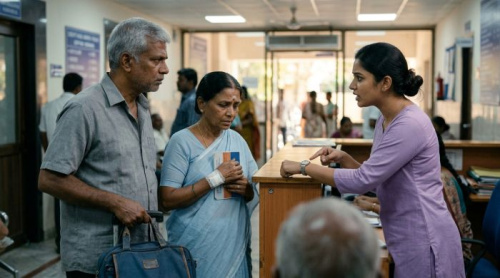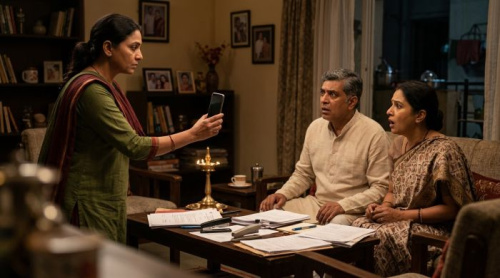
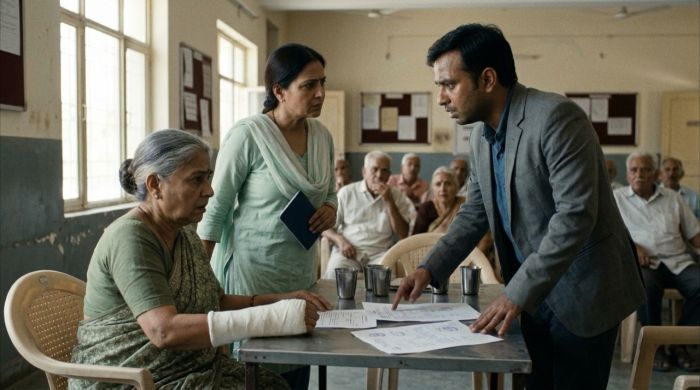
An uninvited young man in a creased grey blazer slid a freshly stamped General Power of Attorney across the folding table at the Shanti Kunj Community Hall, politely congratulating Gayatri Devi Sharma on signing over authority for her Malviya Nagar house and twenty-eight lakh rupees in fixed deposits at eleven-twenty that morning.
Across the steaming stainless-steel tea urn, Gayatri Devi stared down at the thick white orthopedic plaster cast encasing her right forearm since Tuesday evening—an arm so swollen she had not left her daughter-in-law's side at the hospital or the community hall since nine o'clock, and could not even lift a steel spoon.
For three full seconds, nobody near the refreshment counter breathed.
Even the ceiling fans above the community hall seemed to rattle louder in the sudden stillness.
Forty-four-year-old Ananya Sharma, still holding a folded attendance register for her school's Saturday audit, stepped neatly between the stranger and her mother-in-law's plastic chair.
"Excuse me," Ananya said, her voice dangerously calm. "Who sent you into a residents' welfare meeting, and whose name is printed on that stamp paper?"
The stranger—barely thirty, with restless eyes and a scuffed faux-leather folder tucked under one elbow—blinked behind his rimless spectacles and forced an easy smile.
"Madam, I am Harish Pareek, verification executive with Dhanvarsha Private Finance," he said briskly, tapping the top green sheet. "I have come directly from Sector Four as instructed by Mr. Vikram Bhardwaj. Maaji here authorized an urgent eighteen-lakh-fifty-thousand-rupee bridge facility against her property and Bank of Baroda Senior Citizens' deposit at eleven-twenty."
He turned smoothly toward Gayatri Devi, lowering his head in practiced respect.
"Maaji, Bhardwaj ji told me you are resting here after your morning clinic visit. If you can kindly hand over the original Malviya Nagar sale deed and confirm the four-digit bank mandate OTP, our Saturday clearing desk will release the funds before two."
Gayatri Devi's left hand trembled so violently against her cotton saree pallu that her reading glasses clattered onto the vinyl tablecloth.
"Sign?" she whispered, her voice cracking in front of eighteen retired neighbors who had paused mid-sip with their clay kulhads of ginger tea. "My right wrist has been broken since Tuesday night! I cannot even button my own blouse! How could I stand in any office at eleven-twenty?"
A murmur rippled through the long rows of plastic chairs.
Mrs. Savitri Verma from Row Three leaned forward, clutching her walking stick. "Wait a minute—didn't Ananya bring Gayatri sister straight here from Santokba Durlabhji Hospital in an auto just half an hour ago?"
"We sat together in the orthopedic waiting hall from nine-fifteen until noon," Ananya said evenly, her eyes locked onto the green non-judicial e-Stamp border on Harish's table. "My mother-in-law has not signed a single sheet of paper all week. Take back whatever forged rubbish you brought here before I dial the Malviya Nagar police."
Harish Pareek's polite smile vanished instantly.
"Forged?" His voice jumped half an octave as three retired men near the entrance stood up to look. "Madam, watch your language! I am holding a valid five-hundred-rupee Rajasthan e-Stamp Power of Attorney with Maaji's thumb impression, notary seal, and Aadhaar photocopy! Your own relative—Vikram ji—called me twenty minutes ago saying everything was cleared!"
Before Ananya could pick up the paper to check the certificate number, the double wooden doors at the back of Shanti Kunj Community Hall swung open with a sharp bang.
Vikram Bhardwaj walked in briskly, wearing a crisp cream linen kurta and smelling faintly of cardamom mouth freshener.
Behind him trailed his wife, Pooja, carrying a bright pink sweet box from Laxmi Mishthan Bhandar as though they had dropped by for a festive family visit.
"What is all this shouting about?" Vikram asked, his smooth baritone carrying easily across the hall. "I heard Badi Maa's voice from the parking gate!"
He spotted Harish Pareek by the tea table, and for a fraction of a second—so brief only Ananya noticed—his jaw tightened.
Then, with practiced theatrical grace, Vikram hurried over and dropped onto one knee beside Gayatri Devi's chair.
"Badi Maa, what happened? Why are you shaking like this?"
"Vikram!" Gayatri Devi gripped his forearm with her good left hand, tears pooling instantly in her eyes. "This boy says you sent him with a Power of Attorney! He says I signed away our house and my pension deposits at eleven o'clock today!"
Vikram froze.
He turned slowly toward Harish Pareek, widening his eyes in staged astonishment, and then pivoted straight toward Ananya before anyone else could speak.
"Wait a second," Vikram said, rising to his full height and pointing an accusing finger across the tea urn. "Harish, why are you standing here with those papers? Who gave you Badi Maa's Aadhaar copy and old property file?"
Harish stumbled back half a step, his mouth falling open. "Sir—Vikram ji, you yourself called me from—"
"Don't drag my name into your fraud!" Vikram snapped, cutting him off with booming indignation that made half the elderly neighbors flinch. "I told you on Tuesday to verify if Badi Maa wanted a senior citizen medical loan inquiry—I never authorized any Power of Attorney! Look around this room! Who in this entire family works with legal files, bank vouchers, and stamp papers every single day?"
Every pair of eyes in Shanti Kunj Community Hall shifted slowly toward Ananya.
A cold knot tightened in Ananya's stomach. She had seen men deflect blame before in school committee meetings, yet watching Vikram weave poison in front of twenty neighbors who already distrusted her felt like watching floodwater creep under a locked door.
"Everyone in Shanti Kunj knows the truth," Vikram continued, pitching his voice like a wounded son defending a helpless mother. "For three whole years, Ananya Bhabhi has kept Badi Maa's Bank of Baroda passbook, chequebook, and original house papers locked inside her steel cupboard at Vidya Bhavan School! She doesn't even let Badi Maa keep her own ATM card at home!"
Pooja stepped smoothly beside Gayatri Devi, patting her back while shooting a sharp glance toward the watching women in Row Two.
"Tell them, Badi Maa," Pooja murmured softly—loud enough for the nearest table to hear. "Didn't you tell me last month at the temple that Ananya refuses to show you your own bank balance? That she locks her office drawer and shouts whenever you ask about Siddharth bhaiya's life insurance money?"
"I never shouted at Ma," Ananya said quietly, though her throat felt dry as ash. "Not once."
"Then why are her property papers sitting in your school office instead of her own bedroom almirah?" Vikram pressed, stepping closer to the folding table. "You are an accounts clerk! You know how to print forms, match bank mandates, and copy Aadhaar numbers! Did you think nobody would catch you if you pushed the blame onto me the moment this agent walked in?"
Harish Pareek looked wildly from Vikram's furious face to the twenty hostile senior citizens closing in around the table.
Clearly terrified of being cornered alone in a strange colony, Harish clutched his folder tightly against his chest. "Look, I only follow instructions from whichever family member pays the processing fee—I didn't forge anything!"
"Enough!" Gayatri Devi cried out, her voice trembling with a mixture of humiliation, exhaustion, and three years of festering doubt.
The hall fell quiet again.
Gayatri Devi looked up at Ananya—not with anger this time, which might have been easier to bear, but with a hollow, heartbroken betrayal that pierced straight through Ananya's ribs.
"Ananya," Gayatri Devi said softly, her eyes shiny with tears. "For three years, when neighbors asked why my daughter-in-law carried my bank passbook inside her office handbag, I defended you. Even when you stopped letting Vikram stay for dinner, even when you cut off my landline extension at night, I told myself you were just grieving Siddharth in your own hard way."
She gestured weakly with her left hand toward the white plaster cast resting in her lap.
"I broke my arm four days ago. You insisted on dragging me straight from the hospital to this camp before going to your school audit. Tell me honestly in front of Mathur sahab and everybody here—is my house deed still safe in your cupboard? Or have you already pledged it?"
Across the hall, sixty-four-year-old Kuldeep Mathur, a retired senior manager from Bank of Baroda and the elected secretary of Shanti Kunj Housing Society, removed his half-moon reading glasses and walked forward calmly.
"Nobody is jumping to conclusions in a public tea hall," Kuldeep Mathur said in his measured banker's tone. "Ananya beti has lived in this society for nineteen years without a single complaint against her character. And Vikram ji is also known to all of us. If the papers in question are at Vidya Bhavan School five minutes away, let us go there right now—all of us—and check the cupboard with our own eyes."
Vikram's eyes flickered briefly toward the exit. "Mathur sahab, why disturb Badi Maa with another trip? She just got her cast checked—"
"I am coming," Gayatri Devi interrupted firmly, pushing herself upright with her left arm. "If I do not see my own papers before sunset, I will not survive tonight's blood pressure."
Ananya looked at her mother-in-law's pale face, then at Vikram's stiff smile, and felt a strange, heavy clarity settle over her chest.
For three years she had swallowed insults, whispered rumors, and Gayatri Devi's silent coldness because she had promised herself one thing the night she lit Siddharth's funeral pyre: she would protect his mother's roof and dignity even if the old woman hated her for it.
Now, standing under the buzzing tube lights of the community hall, Ananya realized that silence had finally run out of road.
"Let us go to my office, Ma," Ananya said steadily, picking up her canvas tote and meeting Vikram's gaze without blinking. "Mr. Mathur, please bring this agent along too. Nobody leaves until every single paper is placed on my desk."
The auto-rickshaw ride from Shanti Kunj in Malviya Nagar to Vidya Bhavan Higher Secondary School in Tilak Nagar took barely eleven minutes, yet inside the cramped vehicle the silence felt heavier than monsoon air.
Gayatri Devi sat pressed against the left canvas flap, cradling her plastered right forearm against a folded cotton dupatta so the potholes along JLN Marg would not jar the fresh bone fracture.
Beside her, Ananya sat straight-backed on the edge of the seat, gripping the steel support rod with knuckles turned pale.
Behind them, Kuldeep Mathur followed on his silver Honda Activa with Harish Pareek riding nervously on the pillion behind Vikram's white Swift Dzire—Vikram having insisted at the last second that Pooja stay behind at the society gate to "watch the house," though Ananya had watched Pooja hurriedly tapping messages on her phone before stepping out of sight.
As the auto-rickshaw turned past the painted yellow brick gates of Vidya Bhavan School, memories washed over Ananya with a sudden, stinging sharpness she had kept locked behind spreadsheets and school fee ledgers for five long years.
She remembered the November morning five years ago when she had stood outside the mortuary at Sawai Man Singh Hospital in a crumpled cotton sari, holding eleven-year-old Rohan's icy hand while two highway patrol constables handed over Siddharth's cracked wristwatch and broken spectacles.
Siddharth had been only forty-one—an honest, soft-spoken regional auditor for a dairy cooperative who refused bribes even when contractors slipped envelopes under his scooter seat. A speeding gravel dumper near Dudu on the Jaipur-Ajmer highway had ended seventeen years of quiet, affectionate marriage in less than ten seconds.
In the weeks that followed, relatives arrived in waves of loud weeping and cheap sympathy, stayed for three cups of tea, and vanished the moment the thirteenth-day mourning rituals ended.
Two people remained inside the two-storey house in Shanti Kunj: Ananya, suddenly widowed at thirty-nine with a boy entering Class Six, and Gayatri Devi, sixty-three, who stopped eating properly and spent entire afternoons sitting beside Siddharth's framed garlanded photograph on the veranda swing.
At first, they had clung to each other in grief.
Ananya had applied for a permanent administrative clerk position at Vidya Bhavan School—using her old commerce degree and years of home bookkeeping—starting at eighteen thousand rupees a month and climbing slowly over five years to thirty-two thousand. Every evening after returning from school at four, she tutored two neighborhood girls in Class Eight mathematics for an extra four thousand rupees, cooked dinner before nine, and checked Gayatri Devi's blood pressure strip before going to bed.
Nobody outside their iron gate knew how badly Siddharth's sudden hospitalization and final ICU stay at a private trauma center had wiped out their small joint savings.
There had been no millionaire uncle waiting in the wings, no secret trust fund, no sudden windfall.
There was only Ananya's gold chain sold discreetly to cover the six-and-a-half-lakh-rupee hospital clearance, Rohan's simple government-aided school textbooks bought second-hand in Chaura Rasta, and Gayatri Devi's modest Central Government family pension of twenty-nine thousand four hundred rupees alongside the twenty-eight lakh rupees her late husband had parked safely in a Senior Citizens' Savings Scheme and two Bank of Baroda fixed deposits.
"Keep your money untouched in the bank, Ma," Ananya had told Gayatri Devi gently during that first lonely winter. "Siddharth left us a roof without a single rupee of bank loan on it. As long as I can type and balance ledgers, Rohan and I will manage the kitchen."
For two years, Gayatri Devi had blessed her every morning.
Then Vikram Bhardwaj moved back to Jaipur from Kota after his textile agency collapsed.
Vikram was Gayatri Devi's younger sister Kamla's only son—handsome in a breezy, talkative way, always dressed in crisp ironed kurtas, always remembering to touch Gayatri Devi's feet whenever he walked through the gate.
While Ananya left the house at seven-thirty every morning with a steel tiffin carrier and returned exhausted at six with ink on her fingers and grocery bags cutting into her palms, Vikram appeared at eleven in the morning when the house was quiet.
He brought hot jalebis from Sodhani Sweets. He sat beside Gayatri Devi on the veranda swing for an hour listening to her stories about Siddharth's childhood. He drove her to Birla Mandir on Tuesdays in his gleaming white Swift, calling her "Badi Maa" in a voice warm enough to melt any grieving mother's loneliness.
Ananya had been grateful at first—truly relieved to see colour returning to her mother-in-law's cheeks.
Until one humid Tuesday afternoon three years ago, when Ananya took half a day's leave for Rohan's parent-teacher meeting and walked into Bank of Baroda's Malviya Nagar branch to update Gayatri Devi's passbook after noticing the monthly interest SMS had not arrived on Gayatri's keypad phone.
The teller, a middle-aged woman who recognized Ananya immediately, slid the updated passbook across the counter with a casual remark.
"Tell Maaji to keep track of her bearer cheques, Ananya ji. Four self-cheques of sixty thousand rupees each in ten days is quite high for household groceries."
Ananya had stood frozen beneath the bank's buzzing air conditioner, staring at four consecutive debit lines totaling two lakh forty thousand rupees.
None of the entries matched a single electricity bill, hospital receipt, or property tax challan at home.
When Ananya politely requested copies of the paid cheque slips and counter register under Gayatri Devi's senior citizen authorization letter, the counter clerk turned the monitor slightly and pointed to the signature on the reverse side of all four bearer cheques—followed by the Aadhaar-verified name of the collector who had walked out with bundles of five-hundred-rupee notes.
Vikram Bhardwaj.
And on the front of the fourth cheque, the date had been slightly smudged where Gayatri Devi's shaky arthritic hand had signed only the blank signature line—never filling in the amount or the words Self.
That evening, instead of marching straight into the living room and shattering Gayatri Devi's fragile heart, Ananya had waited outside on the driveway until Vikram's Swift pulled up under the neem tree.
She had confronted him quietly by the gate with the bank slip dates written in her palm.
At first Vikram had laughed it off—claiming "Badi Maa asked me to withdraw cash for a fixed-deposit renewal at another post office."
When Ananya pulled out the branch confirmation proving no post office deposit existed and asked why he had taken blank signed cheques from an elderly woman with failing eyesight, Vikram's smile collapsed into ugly desperation.
He had admitted—whispering furiously behind the parked scooter—that he owed nearly two lakh fifty thousand rupees in intraday commodity losses and needed sixty days to rotate it back. Then, seeing Ananya reach toward the iron gate, he had grabbed her elbow and hissed a threat that chilled her blood faster than any slap.
"Go ahead and tell her, Bhabhi!" Vikram had whispered, his breath sharp against her ear. "Tell a sixty-five-year-old woman with high blood pressure that her own sister's son cheated her! Let's see what happens when she lands in the ICU—and while she's lying there, I'll tell every neighbor in Shanti Kunj that you fought with Siddharth before his highway trip and now you want him forgotten so you can control her house alone!"
Ananya had stared at him, stunned by the sheer cruelty of a man who could drink tea from her mother-in-law's kitchen in the morning and threaten her peace by dusk.
She knew Gayatri Devi's fragile pride. Three months earlier, Gayatri Devi's blood pressure had shot to two hundred over one-ten just over a minor argument with a milk vendor. If Gayatri discovered that Vikram—the boy she treated like Siddharth's living shadow—had bled two lakh forty thousand rupees out of her emergency savings, the shame and heartbreak could trigger a stroke.
So Ananya made a silent, agonizing choice that cost her everything she owned of her past.
The very next afternoon, after school hours, Ananya took a bus to Johari Bazaar, walked into the heritage jeweller's shop where Siddharth's parents had bought her wedding set nineteen years earlier, and sold her six-tola bridal gold bangles and heavy gold necklace for two lakh forty-five thousand rupees—accepting the NEFT transfer straight into her personal account.
Without telling a soul, she transferred two lakh forty thousand rupees right back into Gayatri Devi's reserve account, walked into Bank of Baroda the following morning with a formal written request from Gayatri's joint-alert mandate form (which Gayatri signed thinking it was a routine "senior citizen safety update"), and requested the branch manager to place an in-person dual verification lock on any premature FD withdrawal or cheque above twenty thousand rupees.
Then, quietly, Ananya removed the old chequebook and the original Malviya Nagar house sale deed from the unlocked living-room drawer—which Vikram could access whenever Ananya was at school—and locked them inside her personal steel almirah at Vidya Bhavan School.
She stopped inviting Vikram for Sunday lunches. She intercepted unknown courier envelopes at the gate. When Gayatri Devi started forgetting whether she had taken her morning thyroid tablet or whether she had spoken to Pooja the day before, Ananya started taking Gayatri along to Tilak Nagar on Saturday mornings during half-day audits instead of leaving her alone in an empty house where Vikram's "investment friends" had begun ringing the doorbell.
To Vikram and Pooja, Ananya's silent wall was a gift from heaven.
They whispered to Gayatri Devi during Tuesday temple drives that Ananya was ashamed of her, that Ananya hid the passbook because she was quietly siphoning pension money for Rohan's college coaching, and that Ananya kept Gayatri locked in a school office on Saturdays like an unpaid watchwoman.
And Gayatri Devi—lonely, grieving, starved of gentle words because Ananya came home too exhausted to smile easily—slowly began to believe them.
"Wait here, Ma," Ananya said softly now as the auto-rickshaw braked beside Vidya Bhavan School's iron gate, snapping her back to the crisp November afternoon.
She paid the driver forty rupees from her coin purse and stepped down first, offering her steady shoulder so Gayatri Devi could balance safely without bumping her plastered right arm against the metal frame.
Gayatri Devi pulled back half an inch, refusing Ananya's touch and resting her left hand lightly on Kuldeep Mathur's offered forearm instead.
That small, silent recoil hurt sharper than anything Vikram had shouted inside the community hall.
Yet Ananya straightened her dupatta, nodded respectfully to the elderly school gatekeeper Bhairon Singh, and led the strange procession across the quiet brick courtyard toward the ground-floor Accounts & Trust Office.
The ground-floor Accounts & Trust Office of Vidya Bhavan Higher Secondary School smelled faintly of chalk dust, damp ledger paper, and lemon floor cleaner.
Because it was Saturday afternoon, the wide corridor outside was deserted except for the rhythmic ticking of the round wall clock above the principal's closed door and the distant bicycle bell of a newspaper hawker on Tilak Nagar main road.
Ananya unlocked the heavy teak door, switched on two ceiling fans, and stepped aside so Kuldeep Mathur could help Gayatri Devi settle into the cushioned visitor chair beside the long laminate desk.
Harish Pareek lingered anxiously near the doorway, wiping sweat from his upper lip with the back of his hand while clutching his faux-leather folder against his ribs.
Vikram Bhardwaj, however, walked straight into the center of the room as though he owned the building, planting both palms on Ananya's wooden desk and glancing meaningfully at the tall olive-green Godrej steel almirah in the corner.
"There it is, Badi Maa," Vikram said briskly, keeping his voice pitched smoothly for Kuldeep Mathur's ears. "Every school clerk keeps one private locker for campus keys—and look how neatly Bhabhi tucked your entire life behind that steel door. Go ahead, Ananya Bhabhi. Open it in front of Mathur sahab before we call the Malviya Nagar station."
Ananya did not answer him.
She reached into the zipped inner pocket of her plain cotton handbag, pulled out a single brass key attached to a worn red plastic tag, and placed it gently in Gayatri Devi's uninjured left palm.
"I did not bring you here to argue, Ma," Ananya said softly. "You do not have to believe a single word I say. Open the top shelf with your own hand, or ask Mathur uncle to turn the lock while you watch."
Gayatri Devi stared down at the small brass key resting across her pale fingers.
Her breath came in shallow, uneven puffs. For three years she had imagined that steel cupboard holding secret investment certificates or loan notices signed in her name behind her back.
Slowly, she held the key out toward Kuldeep Mathur. "Brother Kuldeep... please open it. My eyes are blurring."
Kuldeep Mathur took the brass key with solemn courtesy, walked three paces to the olive-green Godrej almirah, and turned the heavy handle.
The metal door swung open with a dry click.
Vikram leaned forward instinctively, a triumphant smirk already forming at the corner of his mouth—certain that whatever file came out would muddy the water enough to buy him forty-eight hours of escape.
Instead, there were no dusty lockboxes, no hidden cash bundles, no secret property agreements.
On the middle steel shelf sat three plain, cleanly labeled items resting beside Ananya's school fee receipt registers: a transparent blue zip-folder holding the original Malviya Nagar sale deed with its red sub-registrar ribbon completely intact, a laminated Bank of Baroda senior citizen passbook inside a faded cloth sleeve, and a thin spiral-bound household expense notebook with neat blue ballpoint columns.
Kuldeep Mathur lifted the blue zip-folder first and turned every page carefully under the tube light, checking the property schedule, the municipal tax receipts, and the original Jaipur Development Authority allotment sheet.
"Zero mortgage stamps," Kuldeep Mathur announced calmly, glancing over his spectacles at Gayatri Devi. "No bank lien endorsement. Not a single corner torn or altered, Gayatri ji. Your house deed has not moved an inch."
Vikram's smirk stiffened. "Of course the original deed is still there—she only needed photocopies to pledge a bridge loan! Check the passbook! Check where Badi Maa's pension and fixed deposits went!"
Ananya reached across the desk, opened the cloth-sleeved Bank of Baroda passbook to the most recent printed page, and laid it flat directly in front of Gayatri Devi.
"Read the total yourself, Ma," Ananya said quietly.
Gayatri Devi leaned forward, her left hand steadying her spectacles as her eyes moved down the neat dot-matrix figures.
Her mouth parted slightly.
Every single month's twenty-nine-thousand-four-hundred-rupee Central Government family pension stood credited on time.
Not one rupee of her twenty-eight-lakh-rupee Senior Citizens' Savings Scheme and fixed deposits had been broken, pledged, or transferred out.
In fact, the available savings balance was nearly three lakh rupees higher than she remembered.
"Wait..." Gayatri Devi frowned, tapping a printed line near the top of the current passbook booklet with one trembling finger. "How is there a two-lakh-forty-thousand-rupee credit here from three Novembers ago? I never deposited two lakhs in November."
The office fell abruptly silent.
Vikram shifted his weight from one leather sandal to the other, his eyes darting briefly toward the corridor door.
"Badi Maa, that must be old interest maturity—" Vikram began quickly.
"No, Vikram," Ananya cut in, her voice suddenly quiet as winter rain. "Interest never arrives by NEFT from a personal account at Johari Bazaar."
She picked up her own modest Samsung smartphone from her handbag, opened her Bank of Baroda mobile banking archive, and placed the illuminated screen beside the passbook.
"Tell Ma what happened in the first week of November three years ago," Ananya said, turning her steady gaze straight onto Vikram for the first time since they left the community hall. "Tell her why four bearer cheques of sixty thousand rupees each cleared across the Malviya Nagar branch counter while I was at school."
Vikram's throat moved visibly as he swallowed. "I—I don't know what rubbish you're digging up from three years back—"
"Four bearer cheques," Kuldeep Mathur repeated sharply, his retired banker's instinct catching fire immediately as Ananya flipped two printed bank counter acknowledgment slips out from the back pocket of the passbook sleeve. "Sixty thousand each. Paid over the counter within ten days."
Kuldeep Mathur squinted closely at the small branch-stamped photocopy attached behind the acknowledgment slip—a routine photocopy Ananya had paid fifty rupees in branch archival fees to keep legally documented three years earlier.
"And here is the back of each cheque," Kuldeep Mathur read aloud, his voice dropping an octave. "Collected by Vikram Bhardwaj. Mobile ending in seven-four-two-nine. Verified against PAN."
Gayatri Devi gasped, clutching the edge of the laminate desk as though the floor beneath her chair had tilted.
"Vikram?" she whispered, staring up at the nephew who had driven her to Birla Mandir every Tuesday morning. "Two lakh forty thousand rupees? You took four cheques from my drawer when I signed my name for the society Diwali donation?"
Vikram stepped backward until his shoulder hit the edge of the visitor chair. "Badi Maa, listen to me—my cotton yarn payment was stuck in Kota! I only borrowed it for two months! I swear I was going to put it back—"
"Then why didn't you tell me?" Gayatri Devi's voice broke across the quiet office, sharp with sudden horror. "And why does my passbook show two lakh forty thousand returned four days later?"
Slowly, Gayatri Devi turned her bewildered eyes away from Vikram and looked down at Ananya's bare wrists.
Then she looked at Ananya's bare throat, where only a thin black cotton thread now held Siddharth's tiny silver wedding locket—where six heavy, hand-carved gold bangles and a two-tola bridal necklace used to shine every festival morning until three Novembers ago.
Ananya had told her back then that gold felt uncomfortable while typing school registers, and Gayatri Devi had muttered irritably to Pooja that Ananya probably kept her bridal jewellery locked away at her parents' house in Alwar so her mother-in-law could never admire it.
Now Gayatri Devi stared at the Johari Bazaar jeweller's NEFT transfer entry printed beside her own passbook deposit line—2,45,000 CR on November 9, followed the exact same afternoon by 2,40,000 DR — Transfer to Mrs. Gayatri Devi Sharma—and felt a wave of nausea rise in her chest.
"You sold your wedding gold," Gayatri Devi whispered, her voice barely audible above the ceiling fan. "Siddharth's mother-and-father gift... you sold it in Johari Bazaar to cover what he stole from me?"
Ananya looked down at her hands resting quietly on the desk.
"Your blood pressure had crossed two hundred just three months earlier, Ma," Ananya answered simply, without a trace of self-pity. "The doctor warned us another sudden emotional shock could trigger a stroke. When I found out outside our gate, Vikram told me if I exposed him, he would tell you I caused Siddharth's stress before his highway trip."
Vikram's face turned mottled crimson. "Don't turn this into a Hindi film lecture!" he snarled, his smooth charm cracking completely under the bright tube light. "Fine! I took a temporary loan three years ago and lost my nerve! That was three years ago!"
He spun back toward Kuldeep Mathur and pointed furiously at Harish Pareek's faux-leather folder still resting on the corner of the desk.
"That does NOT explain today! Why is there a freshly stamped five-hundred-rupee Rajasthan Power of Attorney executed at eleven-twenty this morning? I don't work with stamp papers—Ananya does! Look at Badi Maa's plaster! Everyone knows only Ananya has been keeping Badi Maa's Aadhaar and property photocopies in this very office!"
Harish Pareek swallowed hard, looking desperately between Vikram and Kuldeep Mathur. "Sir—Vikram ji, please don't lie now! You called me at nine-thirty this morning from your second number and told me the stamp paper was already typed at Sector Four!"
"Shut up!" Vikram barked. "You're probably in league with her to trap me!"
"Stop shouting inside a school office," Kuldeep Mathur commanded sharply.
The retired bank manager leaned down over Harish's folder, adjusted his half-moon reading glasses over the bridge of his nose, and picked up the green-bordered ₹500 Rajasthan e-Stamp certificate clipped to the front of the Power of Attorney.
For twenty seconds, nobody spoke.
Kuldeep Mathur was not looking at the forged thumbprint at the bottom of page three, nor at the crooked notary stamp beside Gayatri Devi's misspelled middle name.
His thumb traced slowly down the printed barcode strip along the upper right margin of the e-Stamp sheet—to the twenty-digit e-GRAS Certificate Number (IN-RJ8492017462...), the exact timestamp printed to the second, and the tiny Licensed Stamp Vendor Code stamped cleanly beside the Malviya Nagar Sector Four market seal.
Kuldeep Mathur looked up slowly, a quiet, dangerous calm settling behind his spectacles.
"Vikram," Kuldeep Mathur said softly. "You forgot one simple rule about Rajasthan e-Stamps."
Vikram blinked. "What rule?"
"Every non-judicial e-Stamp above one hundred rupees cannot be printed out of thin air at home," Kuldeep Mathur replied, tapping the barcode with one fingernail. "It is generated live on the state e-GRAS treasury portal against an exact bank or UPI payment reference, a registered vendor ID, and a mandatory buyer's mobile number."
He pointed cleanly at the small blue oval stamp tucked below the barcode.
"Licensed Vendor Number RJ-JPR-418. Sector Four Market, Malviya Nagar. That is Raghavendra Singh's kiosk—and his younger daughter Meera graduated from this very school two years ago."
The colour drained straight out of Vikram Bhardwaj's face.
Before Vikram could lunge for the green sheet, Kuldeep Mathur slipped the e-Stamp firmly beneath his own palm, dialed a saved number on his mobile phone, and pressed the green speaker icon so every person in the room could hear.
Three rings later, a brisk, familiar voice answered over the speaker. "Namaste, Mathur sahab! Everything alright at the society camp?"
"Namaste, Raghavendra ji," Kuldeep Mathur said clearly. "I am sitting inside Vidya Bhavan School's ground-floor accounts office with Ananya Sharma ji and Gayatri Devi ji. Someone just presented a five-hundred-rupee Rajasthan e-Stamp Power of Attorney carrying your vendor seal from this morning—Certificate ending seven-four-six-two. Can you check your e-GRAS portal and come over here for ten minutes?"
There was a brief pause on the line, followed by the rapid click of computer keys.
"Certificate seven-four-six-two..." Raghavendra muttered through the speaker. "Wait one second, Mathur sahab. That was issued at nine-forty-two this morning! And wait—why are you asking about Gayatri Devi ji? Her nephew Vikram ji brought an older lady in a maroon shawl to my notary counter at ten-forty-eight claiming Gayatri ji had throat surgery and couldn't talk!"
Vikram stepped backward so violently he knocked over the spare plastic stool beside the steel almirah.
It hit the tiled floor with a sharp crack that echoed down the empty school corridor.
"He's lying!" Vikram stammered, his hands trembling uncontrollably as he reached toward his kurta pocket for his car keys. "Mathur sahab, that vendor must have mixed up two customers—I have to go check on Pooja—"
"Bhairon Singh!" Ananya called sharply toward the half-open office doorway.
Within five seconds, the school's retired Army gatekeeper—tall, broad-shouldered, still wearing his khaki sweater and brass whistle—stepped neatly into the doorway, blocking the corridor exit without raising his voice.
"Wait right here, Vikram ji," Ananya said calmly, stepping around her desk and placing the school attendance register aside. "Raghavendra ji's counter is four minutes away by scooter. Since you were so eager to prove who forged Ma's papers, surely you can wait ten minutes for the stamp vendor himself."
Twelve minutes later, the faint rattle of a Bajaj Chetak scooter stopped outside the school veranda, and fifty-four-year-old Raghavendra Singh walked straight into the ground-floor accounts office carrying a thick black spiral register under one arm and his Android tablet in the other.
He nodded politely to Bhairon Singh at the door, greeted Gayatri Devi with folded hands, and stopped dead the instant his eyes landed on Vikram Bhardwaj standing pale-faced beside the steel cupboard.
"Arre—Vikram ji is right here!" Raghavendra exclaimed, genuinely startled before looking at Harish Pareek's grey blazer. "Then what is the confusion, Mathur sahab? This gentleman came to my Sector Four counter twice today!"
Kuldeep Mathur gestured calmly toward the empty space on Ananya's laminate desk. "Raghavendra ji, nobody is leaving this room until you show Maaji every single detail of how Certificate ending seven-four-six-two was issued."
Raghavendra did not hesitate for half a second.
He set his spiral e-GRAS register flat beside Gayatri Devi's passbook, tapped open the downloaded state treasury receipt on his tablet, and turned the screen toward Gayatri Devi and Kuldeep Mathur.
"Look at line fourteen," Raghavendra said crisply, pointing with his ballpoint pen. "At 9:42 AM today, Vikram Bhardwaj walked up to my window alone. He requested a five-hundred-rupee non-judicial e-Stamp for a General Power of Attorney naming Gayatri Devi Sharma as first party and Vikram Bhardwaj as attorney holder."
Vikram gripped the edge of the desk, sweat beading visibly across his forehead. "You cannot prove I was alone! Anyone could give my name!"
Raghavendra gave Vikram a dry, unimpressed look—the look of a man who had spent twenty-two years watching desperate men try to bluff past government paperwork outside Collectorate Circle.
"I do not take cash above two hundred rupees without an e-GRAS digital trail, Vikram ji," Raghavendra replied flatly.
He tapped the second tab on his tablet—his shop's BHIM Merchant settlement log—and read the exact UPI reference aloud.
"Five hundred and twenty rupees—five hundred stamp duty plus twenty rupees vendor fee—paid at 9:41 AM from UPI ID meera.khandelwal@okaxis. When I asked why the sender name was Meera Khandelwal, you laughed and told me she was your wife Pooja's younger sister sending money because your own bank server was down."
Gayatri Devi let out a tiny, choked sound, pressing her left fingers against her mouth.
"And that wasn't the strange part," Raghavendra continued, swiping smoothly to his shop's exterior Hikvision counter camera backup stored on his phone. "At 10:48 AM, Vikram ji returned with a private typist's notarized draft and an elderly woman wearing a thick maroon wool shawl pulled tight over her forehead, nose, and chin."
He pressed play and laid the phone squarely between Gayatri Devi and Kuldeep Mathur.
In clear, crisp daylight video, Vikram Bhardwaj appeared right inside the Sector Four kiosk frame, smiling reassuringly while guiding a stooped older woman in a maroon shawl—only her forehead and tired eyes visible beneath the fabric—to press an unbandaged, completely healthy right thumb onto the blue ink pad and then down onto three green-bordered legal pages.
There was no white plaster cast anywhere on her forearm.
"When my notary assistant asked her to lower her shawl to verify her face against the Aadhaar photocopy," Raghavendra said evenly, pausing the video right on Vikram's nervous profile as he shielded the woman's side from the desk, "Vikram ji claimed his aunt had undergone severe throat and jaw surgery two days ago, could not speak or bear cold wind on her face, and needed to finish the bank authorization before boarding an afternoon train to Ajmer."
Kuldeep Mathur looked up slowly from the glowing screen and looked at Gayatri Devi's thick white plaster cast resting motionless on Ananya's desk.
"At ten-forty-eight," Kuldeep Mathur asked softly, "where were you, Gayatri ji?"
"At Santokba Durlabhji Hospital," Gayatri Devi whispered, tears spilling silently down her lined cheeks now as the last stubborn wall of doubt inside her heart shattered into dust. "I was sitting in the orthopedic plaster room while Dr. Bansal checked my wrist X-ray."
Ananya quietly unlocked her phone and placed two automated hospital SMS alerts beside Raghavendra's tablet: 10:14 AM — Registration Fee ₹400 paid by Ananya Sharma, OPD Slip #419, followed by 10:51 AM — Digital X-Ray Checkup & Plaster Review Completed.
The silence inside the Vidya Bhavan accounts office was absolute.
Even Harish Pareek's knees seemed to buckle slightly as the reality of criminal impersonation hit him full force.
Suddenly realizing he was one phone call away from being booked for cheating, forgery, and criminal conspiracy alongside Vikram, Harish dropped his faux-leather folder onto the desk and backed away with both hands raised.
"Sir—Mathur sahab—Maaji, please listen to me!" Harish blurted out, his voice shaking violently. "I swear on my mother I never knew there was a decoy woman! Look at my WhatsApp chats—look right here!"
He fumbled frantically with his phone screen and thrust it toward Kuldeep Mathur.
"Vikram ji came to my DSA counter near Gopalpura Bypass on Wednesday evening! He showed me a photo of Maaji's Aadhaar card and two blank signed pages he claimed were her pre-approved property loan consent! He promised me a forty-thousand-rupee cash commission if I rushed a weekend private finance sanction of eighteen lakh fifty thousand rupees against Maaji's house and FD before Monday noon! He told me his sister-in-law at school was mentally unstable and hoarding the original deed—and he paid five thousand rupees advance just to intercept Maaji at the community hall tea table while Ananya ji was busy!"
Gayatri Devi stared at Harish's words—and then a sudden, sickening memory struck her so hard she gripped the wooden arm of her chair.
"Wednesday..." she breathed, looking around the room with wide, horrified eyes. "Tuesday night I slipped on the wet bathroom marble... Ananya took me to emergency plaster at nine. Then Wednesday afternoon, while Ananya went to school for two hours to sign attendance..."
Her voice dropped to a broken whisper.
"Vikram came home with hot besan laddoos. He told me my government Jeevan Pramaan Digital Life Certificate had failed biometric verification and the pension office would stop my November pension unless I signed two plain declaration sheets for his friend at the bank—and gave him my old Aadhaar card to photocopy!"
Vikram made no move to deny it now. His shoulders slumped visibly, his hands hanging limp beside his cream kurta.
"Wait one more minute," Kuldeep Mathur said suddenly, a sharp thought crossing his retired banker's mind. "Harish said he needed the four-digit bank mandate OTP from Maaji to clear the FD lien. Why wasn't Vikram worried that Bank of Baroda's alert SMS or verification call would go straight to Gayatri ji's own mobile phone?"
Kuldeep Mathur turned toward Gayatri Devi. "Gayatri ji, where is your small keypad Nokia phone?"
Gayatri Devi reached clumsily into her cotton saree pocket with her left hand and pulled out her simple black keypad phone.
"Nobody called me from the bank all week," she murmured confusedly. "Not even when Ananya updated my hospital bill."
Kuldeep Mathur dialed Gayatri Devi's mobile number from his own smartphone and waited.
Gayatri Devi's black keypad phone resting on the wooden desk did not light up. It did not ring. It did not vibrate.
Instead, three seconds later, a muffled ringtone chimed inside Vikram Bhardwaj's front kurta pocket.
Every person in the office stared at Vikram's chest as the small secondary SIM phone inside his pocket buzzed angrily against the thin linen cloth.
Kuldeep Mathur ended the call instantly, picked up Gayatri Devi's keypad phone, and dialed *#21#—the standard Indian telecom call-forwarding inquiry code.
Two seconds later, the tiny monochrome screen flashed a stark message: Voice Calls Forwarded Always To: +91 98290-XXXXX.
"He ran *21* call forwarding on her phone Tuesday night," Kuldeep Mathur said quietly, his voice heavy with disgust as he showed the screen to Gayatri Devi and Ananya. "Every verification call from Bank of Baroda, every automated senior-citizen IVR confirmation—all routed straight into his own pocket while her phone sat silent in her saree."
Ananya closed her eyes briefly, letting out a long, shaky breath she felt as though she had been holding inside her chest for three full years.
That was why Vikram had arrived so eagerly at the house after Gayatri's bathroom fall on Tuesday night, offering to "charge Badi Maa's keypad phone beside the veranda plug" while Ananya washed mud off Gayatri's slippers.
And if Ananya had not quietly changed Gayatri's Bank of Baroda mandate to require in-branch physical verification by both account holders three years earlier—and if she had not refused to leave Gayatri alone in the house today—Vikram would have walked out of Jaipur before Monday morning with eighteen-and-a-half lakh rupees wired out against the family roof and Gayatri's entire retirement cushion.
Vikram suddenly dropped onto his knees beside Gayatri Devi's chair, burying his face against her armrest in noisy, desperate sobs.
"Badi Maa, forgive me! Please, don't call the police!" he choked out, grabbing at the hem of her cotton saree. "Pooja doesn't know half of it—I lost fourteen lakhs in MCX silver futures last year! The recovery agents were threatening to stand outside my Pratap Nagar flat and shout in front of my daughter's school! I was only going to take the bridge loan for six months until my commission cleared—I would never have let them auction your house, I swear on my mother's life!"
Gayatri Devi did not pull her saree aggressively away.
She sat completely still for five long seconds, looking down at the thirty-nine-year-old nephew she had treated like her second son since he was a toddler running barefoot across her courtyard.
Then, slowly, using her left hand to lift the edge of her pallu cleanly out of Vikram's grip, Gayatri Devi spoke in the steady, unmistakable tone that had once quieted forty restless schoolchildren in a single breath.
"You brought recovery debt into your own house through greed, Vikram," Gayatri Devi said quietly, her voice hoarse yet unbroken. "And instead of coming to me like a nephew and asking for honest help—even if I had scolded you—you forged my thumbprint while my wrist was broken."
Her eyes shifted briefly toward Ananya, softening with a grief deeper than anger.
"Worst of all," Gayatri Devi continued, her voice trembling once, "you poisoned me against the one daughter who sold her own wedding bangles to protect my sleep, and spent three years letting neighbors call her a thief so my blood pressure wouldn't rise."
She turned cleanly toward Kuldeep Mathur. "Brother Kuldeep, dial the Malviya Nagar police station. And tell them to bring a lady constable if needed—I want every single forged paper, the stamp vendor's camera clip, and that diverted SIM card recorded on paper before sunset."
"Badi Maa—no, please!" Vikram scrambled upright in panic, backing toward the doorway—only to stop short inches from Bhairon Singh's broad khaki shoulder.
"You won't run anywhere, beta," Bhairon Singh said calmly, folding his arms across his chest. "I served twenty-two years on the border. Stay inside until the jeep arrives."
Twenty minutes later, a white Rajasthan Police Bolero pulled quietly up to the yellow brick porch of Vidya Bhavan Higher Secondary School—no sirens wailing, no dramatic cinema crowd, only the measured authority of Sub-Inspector Narendra Rathore and two constables from Malviya Nagar Police Station stepping into the ground-floor office.
Kuldeep Mathur and Raghavendra Singh laid out the evidence with crisp precision: the forged ₹500 e-Stamp Power of Attorney, Raghavendra's signed e-GRAS transaction printout showing Pooja's sister's UPI payment at 9:41 AM, the 10:48 AM counter camera clip of the decoy woman in the maroon shawl, the hospital OPD and X-ray timestamps proving Gayatri Devi was five kilometers away, Harish Pareek's written confession and WhatsApp messages, and Gayatri Devi's keypad phone showing active *21* call forwarding to Vikram's second number.
Sub-Inspector Rathore listened without interruption, sealed the forged Power of Attorney and Harish's folder inside a brown station evidence sleeve, photographed the call-forwarding screen on Gayatri's Nokia, and had both Vikram Bhardwaj and Harish Pareek sign the seizure memo before escorting them out to the waiting Bolero for formal charges of impersonation, forgery, and attempted elder financial fraud.
Just outside the school gate, Pooja Bhardwaj—who had finally arrived in an auto after Vikram failed to answer her frantic calls—broke into loud, theatrical wailing the moment she saw her husband stepping toward the police jeep.
She spotted Gayatri Devi walking slowly out onto the school veranda beside Ananya and Kuldeep Mathur, and lunged forward toward the steps.
"Badi Maa! Have you lost your mind?" Pooja shrieked, clutching at her dupatta while two passing cyclists slowed near the gate. "How can you hand over your own sister's son to the police because of her lies? Tomorrow morning everyone in the family will curse you!"
Gayatri Devi paused at the top step of the veranda.
She did not raise her voice. She did not argue.
She simply held up her white plaster cast with her left hand—so clearly visible in the slant of the golden afternoon sun—and looked straight into Pooja's panicked eyes.
"Your younger sister Meera sent five hundred twenty rupees on UPI at nine-forty-one this morning to buy a forged stamp paper in my name," Gayatri Devi said evenly. "And your husband hired another woman in a maroon shawl to press her thumb while my arm was broken. Go to Malviya Nagar police station and explain it to the Sub-Inspector—not to me."
Pooja's mouth snapped shut instantly. All colour drained from her cheeks as she stared at Gayatri Devi, realized the game was completely over, and hurried backward toward her auto-rickshaw without another word.
Kuldeep Mathur waited until the police Bolero pulled away toward JLN Marg and the yellow gate closed gently behind them, then placed a reassuring hand near Gayatri Devi's uninjured shoulder.
"I have already dialed 1930 on the National Cyber and Financial Fraud helpline and spoken directly to the Malviya Nagar Bank of Baroda branch manager," Kuldeep Mathur told them gently. "They have logged a permanent fraud-attempt alert on your CIF number and disabled every remote mandate change unless you appear in person. Ananya beti's dual-mandate lock saved every single rupee."
Gayatri Devi nodded slowly, unable to summon another word in front of the retired neighbor.
After Kuldeep Mathur rode off on his silver Activa and Raghavendra promised to bring certified counter copies to the police station on Monday morning, the Tilak Nagar school courtyard fell deeply quiet again.
Golden late-afternoon sunlight slanted across the red neem leaves outside the Accounts & Trust Office.
Ananya walked quietly back inside to switch off the two ceiling fans, lock the steel Godrej almirah, and pack her blue passbook sleeve and attendance register back into her worn canvas tote.
When she stepped out onto the stone veranda, expecting to find Gayatri Devi waiting impatiently by the gate for an auto-rickshaw, she stopped dead.
Gayatri Devi was sitting alone on the low stone bench beneath the neem tree. Her head was bowed slightly, her shoulders shaking in silent, terrible sobs that she had held back in front of the neighbors, the vendor, and the police.
Ananya set her canvas bag down gently on the tiles and hurried over, dropping onto the stone bench beside her mother-in-law.
"Ma..." Ananya whispered softly, reaching instinctively for her thermos of lukewarm water inside her bag. "Please don't cry like this—your blood pressure will shoot up again. Let me get you home and give you your evening tablet."
Gayatri Devi did not reach for the water cap.
Instead, with her trembling left hand, she reached across and caught Ananya's right hand—feeling the rough ink stain along the middle knuckle from twenty years of counting school ledgers, and the pale, bare skin at Ananya's wrist where six heavy gold bangles used to sit.
"Three years, Ananya," Gayatri Devi choked out, pressing her forehead briefly down against their joined hands as tears soaked through her cotton saree sleeve. "Three whole years I served you cold silence at the breakfast table. I stopped asking how your headaches were. I sat in the temple courtyard letting Pooja whisper poison about you while you worked late every evening grading notebooks so my pension wouldn't lose a single paisa."
Ananya felt something warm and unbearable crack open inside her own chest—a wall she had built brick by brick since the night Siddharth's ambulance never made it back from Ajmer.
For five years she had been strong for Rohan, strong for the school principal, strong for the bank clerks, and strong for a mother-in-law who looked straight past her at dinner.
Now, sitting on a quiet school bench beneath the falling neem leaves, Ananya's tears finally spilled over cleanly onto her own pale-blue kurta.
"Ma, please," Ananya whispered, gently sliding her other arm carefully around Gayatri Devi's shoulders without touching the plastered right arm. "Don't ask forgiveness from me. You lost your only son. If I had told you three years ago that Vikram had robbed you, it would have broken the last trust you had left in family."
Gayatri Devi lifted her wet, lined face and looked steadily into Ananya's eyes—truly saw her, perhaps for the very first time since Siddharth's wedding day.
"No, beti," Gayatri Devi said softly, squeezing Ananya's hand with surprising strength. "I had a daughter standing inside my own house every morning making my ginger tea without sugar, checking my blood pressure strip before sleeping, and locking my house papers safely away from wolves—and I was too blind in my grief to recognize her."
When they finally walked out of Vidya Bhavan School's iron gate together twenty minutes later, Gayatri Devi did not pull away from Ananya's shoulder.
She rested her good left hand lightly on Ananya's forearm as they stepped into the auto-rickshaw—just the way she used to during the first winter after Siddharth passed away, before sharp lies came between them.
And at home in Shanti Kunj that evening, when sixteen-year-old Rohan opened the main door wearing his school tracksuit and saw his grandmother's eyes red yet strangely peaceful, Gayatri Devi asked Ananya for something she had not requested in three long years: "Come sit beside me on the veranda swing for ten minutes, beti. Let Rohan make the tea tonight."
The following Saturday morning, the Shanti Kunj Housing Society Community Hall was fuller than usual.
Word of the forged Power of Attorney and the bank call-forwarding trap had traveled swiftly along every sunlit lane of Malviya Nagar—not as cheap veranda gossip, but as a sobering shock to two dozen retired teachers, railway clerks, and widowed pensioners who suddenly realized how easily affection and fake urgency could be weaponized against aging parents living alone.
Ananya stood quietly near the tea counter beside Kuldeep Mathur, wearing the simple pair of thin glass bangles Rohan had insisted on buying for her with his own pocket money from Bapu Bazaar the evening before, while Gayatri Devi sat comfortably in the front row—her white orthopedic cast now decorated neatly with Rohan's blue-pen Get Well Soon, Dadi signature.
Nobody whispered behind their teacups today.
Savitri Verma from Row Three walked straight up before the meeting began, pressed Ananya's hands warmly between her own, and murmured an unforced apology for every hasty look she had cast across the park gate over the last three years.
Then Kuldeep Mathur tapped his brass bell once and held up a simple one-page printed checklist he and Ananya had typed out at Vidya Bhavan School the night before—forty clean copies stacked beside the steel tea urn.
"Before we serve breakfast," Kuldeep Mathur addressed the quiet hall, "Gayatri sister asked me to share five rules that saved her home and twenty-eight lakh rupees last Saturday—because every single fraud today wears a familiar smile first."
He read each line slowly, waiting until several elderly residents pulled out their spectacles to read along:
First, dial ##002# once a month on every senior citizen's mobile phone to instantly cancel hidden *21* call forwarding that silently diverts bank OTP calls to another SIM.
Second, never sign blank pages, plain declaration sheets, or extra Aadhaar copies at home for "urgent Digital Life Certificate (Jeevan Pramaan) or municipal KYC updates"—real government life certificates happen only face-to-face through official biometric machines or registered postmen, never on blank paper.
Third, visit your bank branch in person to activate a Dual-Verification / Prior-Alert Mandate on Fixed Deposits and Senior Citizens' Savings Schemes, ensuring no premature closure or Power of Attorney update can be processed without physical branch confirmation.
Fourth, verify any legal stamp paper by checking its twenty-digit e-GRAS Certificate Number online—because genuine stamp duty always leaves an exact timestamp and bank payment trail.
And fifth, memorize 1930 for immediate financial fraud blocking and 14567, the national Elderline, before fear or embarrassment makes you stay silent.
As the residents murmured in thoughtful agreement and tucked the folded checklists carefully into their kurtas and handbag pockets, Gayatri Devi reached across and patted the empty wooden chair beside her until Ananya sat down.
Outside the tall windows of Shanti Kunj Community Hall, morning sunlight spilled warm and clear across Jaipur's neem trees.
Ananya sipped her ginger tea slowly, feeling for the first time in years the quiet, unshakeable peace of a house where nothing needed to be hidden anymore—because the loudest promises in life fade the moment trouble knocks at the gate, while true loyalty is the quiet hand that kept the lock turned through three thankless winters just so the people inside could wake up safe.